

Ventaja® · Crop nutrition
Ventaja CropFertilizers
Explore Ventaja’s water-soluble crop fertilizers, with nutrient analysis, technical specifications and application rates.
Crop fertilizers
Ventaja®BeetMaxPowder formulation
High-Boron Powder with Magnesium and Manganese


Ventaja® BeetMax
1 kg / 5 kgVentaja® BeetMax is a fully water-soluble powder supplying 11% boron with 3% magnesium and 3% manganese. The combination is built on a single physiological relationship: boron governs the transport of sugars into storage tissue, while magnesium and manganese govern the photosynthetic machinery that produces those sugars. Supplying transport and production capacity together addresses the complete pathway rather than one half of it. The formulation is intended for crops with a high boron requirement and a developing storage organ.
Analysis
| Boron (B) | 11% |
|---|---|
| Magnesium (MgO) | 3% |
| Manganese (Mn) | 3% |
Properties
- pH: 2.5
- EC mS: 0.5
- Solubility: 60 g/L
- Fully water-soluble powder — chloride-free
- Supplied with a chelating and complexing system and an integrated silicate group. Sulphur content 5.2%.
Packing
1 kg / 5 kg
Crops and Application Rates
| Crop | Fertigation rate | Foliar rate | Timing / growth stage |
|---|---|---|---|
| Vegetables (greenhouse) | 3–5 kg/1000 m² | 200–300 g/100 L | Early growth stages, applied preventively |
| Vegetables (open field) | 10–15 kg/ha | 200–300 g/100 L | Early growth stages, applied preventively |
| Fruit trees | 10–15 kg/ha | 200–300 g/100 L | Early growth stages, applied preventively |
| Field crops & ornamentals | 10–15 kg/ha | 150–250 g/100 L | Early growth stages, applied preventively |
Benefits
Agronomic Benefits
- Increased weight and development of the storage organ
- Increased sugar content in storage tissue
- Prevention of the internal breakdown and tissue collapse caused by boron deficiency
- Restored photosynthetic capacity through magnesium and manganese supply
- Structural reinforcement of leaf and stem tissue through silicon deposition
Commercial Advantages
- Transport and production capacity in one product — addressing the complete sugar pathway, not half of it
- Complete dissolution with no residue — protects drippers, filters and spray equipment
- Chloride-free — suitable for salt-sensitive, high-value production
- Chelated micronutrients and an integrated silicate group included — no separate corrective inputs required
- Low electrical conductivity per unit of nutrient delivered, reducing cumulative salt load
Composition and Nutrient System
Composition and Nutrient System
- 11% boron — a concentration matched to crops whose boron requirement is several times that of most field crops
- 3% magnesium and 3% manganese supporting the photosynthetic capacity that generates the transported sugars
- A supporting nitrogen and 5.2% sulphur fraction assisting uptake and enzyme function
- Integrated silicate group providing structural reinforcement of plant tissue
- Chelating and complexing system maintaining element availability; entirely chloride-free
Technology and mode of action
Raw Material Purity and Solubility
- Manufactured from high-purity soluble raw materials that dissolve completely, leaving no insoluble residue in the tank
- The low content of inert carriers and unwanted accompanying ions reduces the electrical conductivity generated per unit of nutrient delivered
- Complete dissolution at 300–350 g/L permits concentrated stock solutions without sediment
- Free-flowing powder with no caking or moisture absorption during storage
- Eliminates the sediment that blocks drippers, filters and spray nozzles
Mode of Action
- Boron forms reversible complexes with sugar molecules, and these complexes are the mechanism by which sugars are loaded and moved through the phloem into storage tissue
- Boron is also structural to the cell wall, cross-linking wall polysaccharides — which is why its deficiency produces internal breakdown and tissue collapse in storage organs
- Boron is immobile in most species: it cannot be remobilised from older tissue, so supply must be continuous rather than corrective
Magnesium and Manganese Function
- Magnesium is the central atom of every chlorophyll molecule — the direct determinant of light-harvesting capacity
- Manganese is the essential cofactor of the water-splitting complex in Photosystem II, the reaction that releases the electrons photosynthesis runs on
- Without both, the plant cannot generate the sugars that boron is present to transport — which is why the three are supplied together
Integrated Silicate System
- Silicon is deposited within cell walls, providing mechanical reinforcement of leaf and stem tissue
- The deposited layer forms a physical barrier that impedes fungal penetration of the epidermis
- Structural strengthening reduces lodging in cereals and other stem-bearing crops
- Improves drought and salinity tolerance through more efficient regulation of transpiration
- Produces a more erect leaf angle, improving light interception across the canopy
- Alleviates aluminium and manganese toxicity in acid soils
Chelation and Micronutrient Protection
- Micronutrients are supplied in chelated form, protecting them against precipitation before they reach the plant
- In alkaline irrigation water and in the presence of phosphate, non-chelated iron, zinc, manganese and copper precipitate within minutes and are lost from availability
- Chelation maintains the plant-available form across the entire path from tank to root surface
- An integrated stabilizing system protects the iron fraction against oxidation, maintaining it in the reduced form the plant actually absorbs
- The acidic reaction of the formulation (pH 3.5–4.5) further supports micronutrient solubility in the root zone
Application, compatibility and storage
Application and Compatibility
- Fertigation via drip and micro-irrigation; compatible with all injection equipment, hydroponic, NFT and substrate systems
- Foliar application at the recommended dilution
- Suitable for all agricultural soil types
- Mixable with most fertilizers and pesticides; a small-scale compatibility test is recommended before tank-mixing
- Storage: dry conditions, away from direct sunlight; keep containers sealed
Ventaja®Corn PowderPowder formulation
Zinc and Manganese Powder with an Acidifying Nitrogen Carrier

Ventaja® Corn Powder
1 kg / 5 kgVentaja® Corn Powder is a fully water-soluble formulation supplying 5% zinc and 5% manganese carried within a 13% ammonium-form nitrogen fraction. The nitrogen fraction is not a diluent: ammonium uptake releases hydrogen ions from the root, lowering the pH of the immediate root zone. This acidification is precisely what raises zinc and manganese solubility, so the carrier and the micronutrients act on the same mechanism. Zinc and manganese are supplied together because both are immobilised by the same soil conditions.
Analysis
| Total Nitrogen (N) | 13% |
|---|---|
| Zinc (Zn) | 5% |
| Manganese (Mn) | 5% |
Properties
- pH: 3.0–3.5
- EC mS: 1.6
- Solubility: 100 g/L
- Fully water-soluble powder — chloride-free
- Sulphur content 21.7%. Includes a complexing system and an integrated silicate group.
Packing
1 kg / 5 kg
Crops and Application Rates
| Crop | Fertigation rate | Foliar rate | Timing / growth stage |
|---|---|---|---|
| Vegetables (greenhouse) | 3–5 kg/1000 m² | 200–300 g/100 L | Early growth stages and at first symptoms |
| Vegetables (open field) | 10–15 kg/ha | 200–300 g/100 L | Early growth stages and at first symptoms |
| Fruit trees | 10–15 kg/ha | 200–300 g/100 L | Early growth stages and at first symptoms |
| Field crops & ornamentals | 10–15 kg/ha | 150–250 g/100 L | Early growth stages and at first symptoms |
Benefits
Agronomic Benefits
- Correction of combined zinc and manganese deficiency in a single application
- Restored photosynthetic capacity through manganese supply to Photosystem II
- Normalised internode extension and leaf expansion through restored hormone synthesis
- Improved protein synthesis and nitrogen use efficiency through the sulphur fraction
- Increased micronutrient availability through root-zone acidification by the ammonium carrier
Commercial Advantages
- The carrier is part of the mechanism — ammonium uptake acidifies the root zone, which is what makes zinc and manganese available
- Complete dissolution with no residue — protects drippers, filters and spray equipment
- Chloride-free — suitable for salt-sensitive, high-value production
- Chelated micronutrients and an integrated silicate group included — no separate corrective inputs required
- Low electrical conductivity per unit of nutrient delivered, reducing cumulative salt load
Composition and Nutrient System
Composition and Nutrient System
- 5% zinc and 5% manganese supplied in balanced proportion within a single application
- 13% ammonium-form nitrogen acting as an acidifying carrier rather than a diluent
- 21.7% sulphur supporting protein synthesis and the enzyme systems the micronutrients activate
- Complexing system maintaining micronutrient availability, with an integrated silicate group
- Fully water-soluble and entirely chloride-free, manufactured from high-purity raw materials
Technology and mode of action
Raw Material Purity and Solubility
- Manufactured from high-purity soluble raw materials that dissolve completely, leaving no insoluble residue in the tank
- The low content of inert carriers and unwanted accompanying ions reduces the electrical conductivity generated per unit of nutrient delivered
- Complete dissolution at 300–350 g/L permits concentrated stock solutions without sediment
- Free-flowing powder with no caking or moisture absorption during storage
- Eliminates the sediment that blocks drippers, filters and spray nozzles
Mode of Action
- Zinc is required for the synthesis of the principal plant growth hormone; deficiency shortens internodes and reduces leaf expansion before any discoloration appears
- Zinc is also a component of the enzyme systems governing carbon dioxide handling, protein synthesis and antioxidant defence
- Zinc availability falls sharply in high-pH and calcareous soils, and is further suppressed by high phosphate application — a well-documented antagonism
Manganese Function and the Shared Limitation
- Manganese is the essential cofactor of the water-splitting complex in Photosystem II — the reaction that supplies the electrons photosynthesis depends on
- Manganese is immobilised by the same soil conditions that immobilise zinc: high pH, high carbonate content and high organic matter
- Because both are limited by one shared cause, correcting either element alone frequently exposes the deficiency of the other
Integrated Silicate System
- Silicon is deposited within cell walls, providing mechanical reinforcement of leaf and stem tissue
- The deposited layer forms a physical barrier that impedes fungal penetration of the epidermis
- Structural strengthening reduces lodging in cereals and other stem-bearing crops
- Improves drought and salinity tolerance through more efficient regulation of transpiration
- Produces a more erect leaf angle, improving light interception across the canopy
- Alleviates aluminium and manganese toxicity in acid soils
Chelation and Micronutrient Protection
- Micronutrients are supplied in chelated form, protecting them against precipitation before they reach the plant
- In alkaline irrigation water and in the presence of phosphate, non-chelated iron, zinc, manganese and copper precipitate within minutes and are lost from availability
- Chelation maintains the plant-available form across the entire path from tank to root surface
- An integrated stabilizing system protects the iron fraction against oxidation, maintaining it in the reduced form the plant actually absorbs
- The acidic reaction of the formulation (pH 3.5–4.5) further supports micronutrient solubility in the root zone
Application, compatibility and storage
Application and Compatibility
- Fertigation via drip and micro-irrigation; compatible with all injection equipment, hydroponic, NFT and substrate systems
- Foliar application at the recommended dilution
- Suitable for all agricultural soil types
- Mixable with most fertilizers and pesticides; a small-scale compatibility test is recommended before tank-mixing
- Storage: dry conditions, away from direct sunlight; keep containers sealed
Ventaja®Potato Powder APowder formulation
High-Phosphorus Powder with Zinc and Magnesium
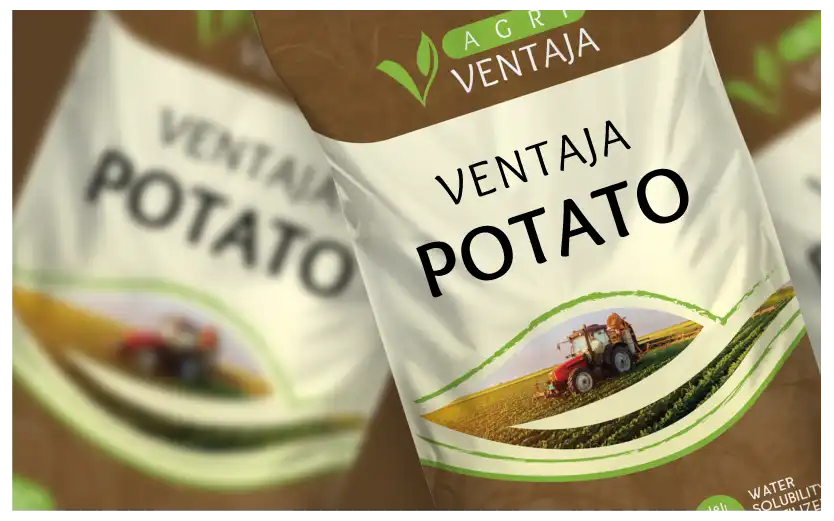
Ventaja® Potato Powder A
1 kg / 5 kgVentaja® Potato Powder A is a fully water-soluble formulation supplying 25% phosphorus with 14% nitrogen, 13% potassium, 3.2% magnesium and 1.8% zinc. The zinc inclusion is deliberate and addresses a specific antagonism: high phosphate application suppresses zinc uptake, so a phosphorus-dominant product without zinc creates the deficiency it cannot then correct. Each macronutrient is drawn from more than one mineral source, and the formulation is entirely chloride-free.
Analysis
| Total Nitrogen (N) | 14% |
|---|---|
| Phosphorus (P₂O₅) | 25% |
| Potassium (K₂O) | 13% |
| Magnesium (MgO) | 3.2% |
| Zinc (Zn) | 1.8% |
| Sulphur (SO₃) | 12.5% |
Properties
- pH: 3.0–3.5
- EC mS: 1.0
- Solubility: 200 g/L
- Fully water-soluble powder — chloride-free
- Includes a chelating system and an integrated silicate group.
Packing
1 kg / 5 kg
Crops and Application Rates
| Crop | Fertigation rate | Foliar rate | Timing / growth stage |
|---|---|---|---|
| Vegetables (greenhouse) | 3–5 kg/1000 m² | 200–300 g/100 L | From storage organ initiation through bulking |
| Vegetables (open field) | 10–15 kg/ha | 200–300 g/100 L | From storage organ initiation through bulking |
| Fruit trees | 10–15 kg/ha | 200–300 g/100 L | From storage organ initiation through bulking |
| Field crops & ornamentals | 10–15 kg/ha | 150–250 g/100 L | From storage organ initiation through bulking |
Benefits
Agronomic Benefits
- Increased development and weight of the storage organ
- Sustained photosynthetic capacity through the accumulation period
- Prevention of the induced zinc deficiency associated with high phosphate programmes
- Improved carbohydrate transport from leaf tissue into storage tissue
- Improved storage quality and post-harvest tolerance
Commercial Advantages
- Zinc supplied within the phosphorus product — pre-empting an antagonism most high-phosphorus formulations leave unaddressed
- Complete dissolution with no residue — protects drippers, filters and spray equipment
- Chloride-free — suitable for salt-sensitive, high-value production
- Chelated micronutrients and an integrated silicate group included — no separate corrective inputs required
- Low electrical conductivity per unit of nutrient delivered, reducing cumulative salt load
Composition and Nutrient System
Composition and Nutrient System
- 25% phosphorus supplied as directly absorbable orthophosphate from two mineral sources
- 1.8% zinc included to offset the phosphate–zinc uptake antagonism the high phosphorus content would otherwise create
- 3.2% magnesium sustaining photosynthetic capacity during the carbohydrate accumulation period
- 14% nitrogen and 13% potassium, each drawn from more than one mineral source
- 12.5% sulphur (SO₃) supplied within the same matrix, supporting protein formation and nitrogen use efficiency
- Chelating system with an integrated silicate group; entirely chloride-free
Technology and mode of action
Raw Material Purity and Solubility
- Manufactured from high-purity soluble raw materials that dissolve completely, leaving no insoluble residue in the tank
- The low content of inert carriers and unwanted accompanying ions reduces the electrical conductivity generated per unit of nutrient delivered
- Complete dissolution at 300–350 g/L permits concentrated stock solutions without sediment
- Free-flowing powder with no caking or moisture absorption during storage
- Eliminates the sediment that blocks drippers, filters and spray nozzles
Mode of Action
- Phosphorus supplies the energy transfer that funds cell division in developing storage tissue, and is the dominant fraction for that reason
- Magnesium is the central atom of chlorophyll and therefore determines the rate at which carbohydrates are produced
- Potassium governs the phloem transport that moves those carbohydrates from leaf tissue into the storage organ
- The three together cover the complete pathway: energy for tissue formation, production of the carbohydrate, and its delivery
The Phosphate–Zinc Antagonism and the Sulphur Fraction
- High phosphate concentrations in the root zone reduce zinc uptake and internal translocation — one of the most consistently documented nutrient interactions
- The result is that heavy phosphorus programmes can induce a zinc deficiency that did not previously exist in the soil
- Zinc is required for synthesis of the principal plant growth hormone; its deficiency restricts internode extension and leaf expansion before any visible discoloration appears
- Sulphur (SO₃) is structural to the amino acids that build storage protein, and is a required cofactor for nitrate reduction — so it raises the return on the nitrogen applied alongside it
- Sulphur contributes to starch accumulation and dry matter content in storage tissue, and to skin finish and appearance at harvest
- Applied sulphur mildly acidifies the root zone, and this acidification suppresses the soil organism responsible for common scab — a quality defect that reduces marketable grade without reducing yield
Integrated Silicate System
- Silicon is deposited within cell walls, providing mechanical reinforcement of leaf and stem tissue
- The deposited layer forms a physical barrier that impedes fungal penetration of the epidermis
- Structural strengthening reduces lodging in cereals and other stem-bearing crops
- Improves drought and salinity tolerance through more efficient regulation of transpiration
- Improved storage protein and dry matter content through the sulphur fraction
- Improved skin finish and reduced incidence of surface quality defects
Chelation and Micronutrient Protection
- Micronutrients are supplied in chelated form, protecting them against precipitation before they reach the plant
- Sulphur included and declared — supporting dry matter, skin finish and marketable grade
- In alkaline irrigation water and in the presence of phosphate, non-chelated iron, zinc, manganese and copper precipitate within minutes and are lost from availability
- Chelation maintains the plant-available form across the entire path from tank to root surface
- An integrated stabilizing system protects the iron fraction against oxidation, maintaining it in the reduced form the plant actually absorbs
- The acidic reaction of the formulation (pH 3.5–4.5) further supports micronutrient solubility in the root zone
Application, compatibility and storage
Application and Compatibility
- Fertigation via drip and micro-irrigation; compatible with all injection equipment, hydroponic, NFT and substrate systems
- Foliar application at the recommended dilution
- Suitable for all agricultural soil types
- Mixable with most fertilizers and pesticides; a small-scale compatibility test is recommended before tank-mixing
- Storage: dry conditions, away from direct sunlight; keep containers sealed
Ventaja®Cereals PowderPowder formulation
Magnesium, Copper and Manganese Powder with Nitrogen Carrier

Ventaja® Cereals Powder
1 kg / 5 kgVentaja® Cereals Powder is a fully water-soluble formulation supplying 5% magnesium, 2% copper and 2% manganese within a 13% nitrogen fraction. The three elements address three separate determinants of grain formation: magnesium and manganese govern the photosynthetic machinery that produces the carbohydrate, while copper governs the structural strength of the stem and the pollen viability on which grain set depends. Copper deficiency in particular produces a yield loss that is not visible until harvest.
Analysis
| Total Nitrogen (N) | 13% |
|---|---|
| Magnesium (MgO) | 5% |
| Copper (Cu) | 2% |
| Manganese (Mn) | 2% |
Properties
- pH: 3.0–3.5
- EC mS: 1.6
- Solubility: 100 g/L
- Fully water-soluble powder — chloride-free
- Includes a chelated micronutrient system and an integrated silicate group.
Packing
1 kg / 5 kg
Crops and Application Rates
| Crop | Fertigation rate | Foliar rate | Timing / growth stage |
|---|---|---|---|
| Vegetables (greenhouse) | 3–5 kg/1000 m² | 200–300 g/100 L | Tillering through to flowering |
| Vegetables (open field) | 10–15 kg/ha | 200–300 g/100 L | Tillering through to flowering |
| Fruit trees | 10–15 kg/ha | 200–300 g/100 L | Tillering through to flowering |
| Field crops & ornamentals | 10–15 kg/ha | 150–250 g/100 L | Tillering through to flowering |
Benefits
Agronomic Benefits
- Increased grain number through restored pollen viability
- Improved structural strength of stem tissue and reduced susceptibility to lodging
- Restored photosynthetic capacity through magnesium and manganese supply
- Improved carbohydrate transport toward developing grain
- Increased micronutrient availability through root-zone acidification by the nitrogen carrier
Commercial Advantages
- Addresses a deficiency that is invisible until harvest — copper limits grain set without altering plant appearance
- Complete dissolution with no residue — protects drippers, filters and spray equipment
- Chloride-free — suitable for salt-sensitive, high-value production
- Chelated micronutrients and an integrated silicate group included — no separate corrective inputs required
- Low electrical conductivity per unit of nutrient delivered, reducing cumulative salt load
Composition and Nutrient System
Composition and Nutrient System
- 5% magnesium — the central atom of chlorophyll, determining the rate at which carbohydrate is produced
- 2% copper — required for lignin formation and for pollen viability at flowering
- 2% manganese — essential cofactor of the water-splitting complex in Photosystem II
- 13% nitrogen acting as a carrier whose uptake acidifies the root zone and raises micronutrient solubility
- Chelated micronutrient system with an integrated silicate group; entirely chloride-free
Technology and mode of action
Raw Material Purity and Solubility
- Manufactured from high-purity soluble raw materials that dissolve completely, leaving no insoluble residue in the tank
- The low content of inert carriers and unwanted accompanying ions reduces the electrical conductivity generated per unit of nutrient delivered
- Complete dissolution at 300–350 g/L permits concentrated stock solutions without sediment
- Free-flowing powder with no caking or moisture absorption during storage
- Eliminates the sediment that blocks drippers, filters and spray nozzles
Mode of Action
- Copper is required for the enzyme that forms lignin — the polymer that gives stem tissue its rigidity. Deficiency reduces structural strength and increases susceptibility to lodging
- Copper is also required for pollen viability. Where copper is limiting, flowering proceeds normally but grain set is poor, producing heads that appear developed while carrying few filled grains
- This makes copper deficiency invisible until harvest — the loss is in grain number, not in visible plant appearance
Magnesium and Manganese — The Production Side
- Magnesium sits at the centre of every chlorophyll molecule and therefore sets the ceiling on light capture and carbohydrate production
- Magnesium is additionally required for the phloem loading of sucrose, so it governs both the production of carbohydrate and its movement toward the grain
- Manganese is the cofactor of the reaction that releases the electrons photosynthesis depends on; its deficiency is common on calcareous soils
- Both are supplied alongside a nitrogen fraction whose uptake lowers root-zone pH and raises their solubility
Integrated Silicate System
- Silicon is deposited within cell walls, providing mechanical reinforcement of leaf and stem tissue
- The deposited layer forms a physical barrier that impedes fungal penetration of the epidermis
- Structural strengthening reduces lodging in cereals and other stem-bearing crops
- Improves drought and salinity tolerance through more efficient regulation of transpiration
- Produces a more erect leaf angle, improving light interception across the canopy
- Alleviates aluminium and manganese toxicity in acid soils
Chelation and Micronutrient Protection
- Micronutrients are supplied in chelated form, protecting them against precipitation before they reach the plant
- In alkaline irrigation water and in the presence of phosphate, non-chelated iron, zinc, manganese and copper precipitate within minutes and are lost from availability
- Chelation maintains the plant-available form across the entire path from tank to root surface
- An integrated stabilizing system protects the iron fraction against oxidation, maintaining it in the reduced form the plant actually absorbs
- The acidic reaction of the formulation (pH 3.5–4.5) further supports micronutrient solubility in the root zone
Application, compatibility and storage
Application and Compatibility
- Fertigation via drip and micro-irrigation; compatible with all injection equipment, hydroponic, NFT and substrate systems
- Foliar application at the recommended dilution
- Suitable for all agricultural soil types
- Mixable with most fertilizers and pesticides; a small-scale compatibility test is recommended before tank-mixing
- Storage: dry conditions, away from direct sunlight; keep containers sealed