

Ventaja® · Specialty fertilizers
SpecialtyFertilizers
Explore Ventaja specialty fertilizers, with nutrient analysis, technical specifications and crop application rates.
Specialty fertilizers
Ventaja®Humic 85% PowderSpecialty fertilizers
Soil Conditioner — Humic and Fulvic Acids with Marine Extract
Product image unavailable
Ventaja® Humic 85% Powder
1 kg / 5 kgVentaja® Humic 85% Powder is a fully water-soluble soil conditioner supplying 80% combined humic and fulvic acids with a 5% marine extract fraction. Unlike a mineral fertilizer, it does not supply a nutrient directly: it changes the capacity of the soil to hold, exchange and deliver nutrients, and the capacity of the root system to acquire them. Its effect is therefore expressed across the entire fertilization programme rather than in a single element.
Analysis
| Humic & Fulvic Acids | 80% |
|---|---|
| Marine Extract | 5% |
Properties
- pH: 9.0–10.0
- EC mS: 0.3
- Solubility: 300 g/L
- Fully water-soluble powder — chloride-free
- Applied through soil irrigation and fertigation. Compatible with standard programmes; a small-scale compatibility test is recommended before tank-mixing.
Packing
1 kg / 5 kg
Crops and Application Rates
| Crop | Application rate | Timing / growth stage |
|---|---|---|
| Vegetables (greenhouse & open field) | 3–5 kg/ha | Throughout the production cycle |
| Fruit trees & vines | 5–8 kg/ha | From bud break through the season |
| Field crops & forages | 3–5 kg/ha | Early growth stages |
| Nurseries & ornamentals | 2–4 kg/ha | At and after transplanting |
Benefits
Agronomic Benefits
- Improved soil structure, aeration and water infiltration
- Increased water-holding capacity, particularly in light and sandy soils
- Higher retention and availability of applied nutrients
- Increased root proliferation, branching and root-hair density
- Higher proportion of applied nutrient actually absorbed, through the carrier fraction
- Potassium supplied at a low salinity index alongside the conditioning effect
Commercial Advantages
- Raises the efficiency of the entire fertilization programme rather than supplying a single nutrient
- Improves the productive capacity of light, sandy, compacted and saline soils
- Reduces nutrient loss below the root zone, lowering effective input cost
- Fully soluble with no residue — protects drippers, filters and equipment
- Compatible with standard fertigation programmes
Composition and Active Fractions
Composition and Active Fractions
- 80% humic and fulvic acids combined — the active fraction that governs soil physical, chemical and biological function
- 5% marine extract contributing natural growth-regulating activity
- A readily available organic-form potassium fraction with a low salinity index, supplied within the same matrix
- A carrier fraction that improves the uptake and internal transport of the complexed nutrients
- A stabilizing component protecting the organic fraction against microbial degradation throughout shelf life
- Fully water-soluble, free-flowing, chloride-free and compatible with standard fertigation programmes
Technology and mode of action
Humic and Fulvic — The Functional Distinction
- The two fractions are chemically distinct and act in different places. Humic acids are higher in molecular weight and function primarily within the soil: aggregation, cation exchange and water retention
- Fulvic acids are lower in molecular weight and remain soluble across the entire pH range. Their size allows them to enter root tissue while carrying a chelated nutrient
- Supplying both means the soil is conditioned and the nutrient is simultaneously carried into the plant — a single fraction cannot do both
Mode of Action in the Soil
- Aggregation: humic substances bind soil particles into stable aggregates, improving aeration, water infiltration and root penetration, and reducing surface crusting and compaction
- Water retention: the humic fraction holds many times its own weight in water, raising the water-holding capacity of light and sandy soils
- pH buffering: the high exchange capacity resists rapid pH movement, stabilising the root-zone environment
- Salinity mitigation: improved structure and exchange capacity assist the displacement and leaching of accumulated sodium
Effect on Nutrient Retention and Availability
- Cation exchange capacity: humic substances carry an exchange capacity several times that of clay minerals, holding potassium, calcium, magnesium and ammonium against leaching and releasing them to the root on demand
- Natural chelation: both fractions complex iron, zinc, manganese and copper, maintaining them in available form rather than allowing precipitation
- Improved fertilizer efficiency: nutrients applied alongside are retained in the root zone for longer, reducing the proportion lost below the root system
Supporting Fractions
- The marine extract contributes natural growth-regulating compounds that stimulate lateral root and root-hair formation, and assists osmotic adjustment following transplanting, heat and salinity stress
- The carrier fraction binds nutrients and improves their movement across root membranes and within plant tissue, raising the proportion of applied nutrient that is actually absorbed
- The organic-form potassium fraction supplies potassium at a low salinity index, and its organic component is metabolisable rather than accumulating as residual salt
- Together with the humic fraction these provide a carbon source and habitat for beneficial soil microorganisms, raising biological activity in the root zone
- A stabilizing component prevents microbial degradation of the organic fractions during storage
Application, compatibility and storage
Application and Compatibility
- Fertigation via drip and micro-irrigation; compatible with all injection equipment, hydroponic, NFT and substrate systems
- Foliar application at the recommended dilution
- Suitable for all agricultural soil types
- Mixable with most fertilizers and pesticides; a small-scale compatibility test is recommended before tank-mixing
Ventaja®DKP 0-30-40Specialty fertilizers
Nitrogen-Free Liquid Phosphorus–Potassium System

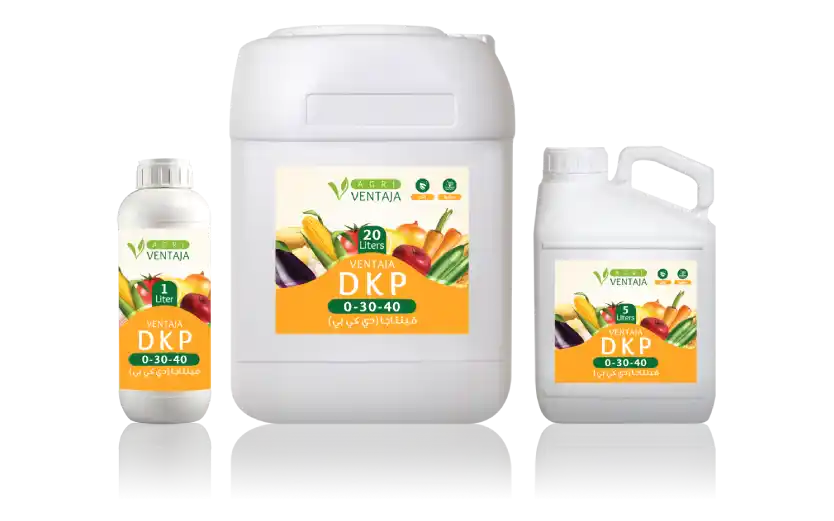
Ventaja® DKP 0-30-40
1 L / 5 L / 20 LVentaja® DKP 0-30-40 is a high-concentration nitrogen-free liquid supplying 30% P₂O₅ and 40% K₂O. The absence of nitrogen is a precise formulation decision: flower-bud differentiation is hormonally regulated, and nitrogen availability is among the strongest signals directing a plant to remain vegetative. The phosphorus fraction is manufactured from purified, gypsum-free phosphoric acid, and delivery is carried by PhytoCarrier transport technology.
Analysis
| Phosphorus (P₂O₅) | 30% |
|---|---|
| Potassium (K₂O) | 40% |
Properties
- pH: 7.5–8.5
- Density: 1.56 g/cm³
- EC mS: 1.1
- Sol (g/L): 100%
- Rates are guidelines; adjust to crop stage, deficiency severity and local practice.
Packing
1 L / 5 L / 20 L
Crops and Application Rates
| Crop | Fertigation rate | Foliar rate | Timing / growth stage |
|---|---|---|---|
| Vegetables (greenhouse) | 2–4 L/500 m² | 2–4 L/ha | During flowering & fruit development |
| Vegetables (open field) | 2–4 L/1000 m² | 2–4 L/ha | During flowering & fruit development |
| Field crops | — | 3–5 L/ha | First month & during heading stage |
| Forages | — | 3–5 L/ha | During the first month |
| Fruit trees | 50–150 ml/tree | — | Flowering and fruit development |
Benefits
Agronomic Benefits
- More uniform and abundant flower initiation
- Improved fruit-set percentage with reduced physiological drop
- Measurable increase in fruit size and weight
- Higher soluble solids content, improved colour and extended shelf life
- Recovery of phosphorus previously fixed and unavailable in the soil
Commercial Advantages
- Purified, gypsum-free phosphorus source — no insoluble sulphate fraction entering the irrigation system
- Complete solubility with no residue — protects drippers, filters and spray equipment
- Chelated micronutrients included — no separate corrective inputs required
- Complete dispersion in water at the point of use, with viscosity controlled for accurate dosing
- Compatible with standard fertigation and foliar programmes
Composition and Nutrient System
Composition and Nutrient System
- Zero nitrogen — removes the vegetative signal during the reproductive transition
- 30% P₂O₅ supplied as fully solubilised orthophosphate from a purified, gypsum-free source
- 40% K₂O from a chloride-free source, safe for chloride-sensitive production
- An organic-acid complexing system maintaining solubility across a wide range of water alkalinity
Technology and mode of action
PhytoCarrier Transport Technology
- Nutrient transport system combining natural carrier molecules built into the formulation
- Enhances penetration through the leaf cuticle and across root membranes, raising uptake efficiency by both foliar and root routes
- Binds and escorts nutrients to the point of metabolism, so a higher proportion of the applied rate is actually absorbed
- Provides osmotic protection under heat and salinity stress
Mode of Action
- Phosphorus drives ATP energy transfer for flower and fruit development and activates the phosphorylation cascades governing cell division in fruit tissue
- It is supplied as orthophosphate — the only form absorbed directly by roots without further metabolic conversion
- The acidic reaction additionally releases phosphorus fixed from previous applications, which remains unavailable in calcareous soils
Potassium Function and Purity of the Phosphorus Source
- Potassium is the dominant cation controlling fruit turgor, phloem sugar loading and the enzyme systems that determine quality
- The phosphorus fraction uses purified acid rather than crude acid. Crude acid carries calcium sulphate, which precipitates as sediment and blocks drippers and filters
- The purified, gypsum-free source dissolves completely, producing a clear solution with no insoluble sulphate fraction
Purity of the Phosphorus Source
- The phosphorus fraction is manufactured from purified phosphoric acid rather than crude acid
- Crude acid carries calcium sulphate (gypsum), which precipitates in the tank and in irrigation lines and forms the sediment that blocks drippers, filters and spray nozzles
- The purified source is gypsum-free: it dissolves completely, produces a clear solution and leaves no residue in the system
- The absence of insoluble sulphate results in a clear solution and eliminates the sediment load carried into the irrigation system
Solubility in Use and Physical Consistency
- The operative specification is complete dispersion in water at the point of use — solubility in the tank, not appearance in the container
- Partial settling can occur in any concentrated suspension during storage. The product is shaken before use, which restores full homogeneity and does not affect the delivered analysis
- A stabilizing component protects the formulation against microbial degradation during storage
- A controlled rheology system governs viscosity, allowing accurate dosing and clean transfer through injection equipment
Application, compatibility and storage
Application and Compatibility
- Shake well before use
- Fertigation via drip and micro-irrigation; compatible with all injection equipment, hydroponic, NFT and substrate systems
- Foliar application at the recommended dilution
- Suitable for all agricultural soil types
- Mixable with most fertilizers and pesticides; a small-scale compatibility test is recommended before tank-mixing
- Storage: 7–30°C, away from direct sunlight; keep containers sealed
Ventaja®KTSSpecialty fertilizers
Liquid Potassium–Sulphur System with Root-Zone pH Management
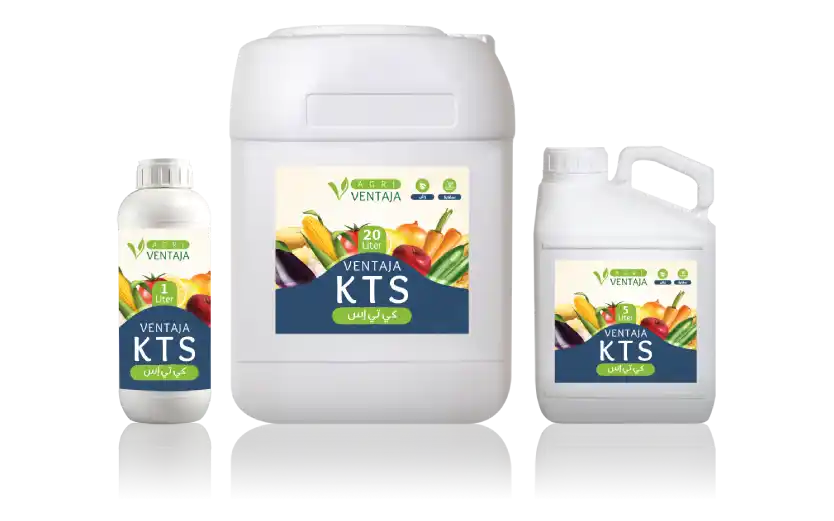
Ventaja® KTS
1 L / 5 L / 20 LVentaja® KTS supplies 36% potassium and 25% sulphur in a single chloride-free liquid. Both elements are molecularly associated and fully solubilised, which gives synchronised uptake and removes the precipitation risk that arises when potassium and sulphur are applied from separate sources. The formulation carries an inherent root-zone acidification capacity that raises the availability of phosphorus, iron, zinc and manganese.
Analysis
| Potassium (K₂O) | 36% |
|---|---|
| Sulfur (S) | 25% |
Properties
- pH: 11.0–12.0
- Density: 1.40 g/cm³
- EC mS: 1.1
- Sol (g/L): 100%
- Rates are guidelines; adjust to crop stage, deficiency severity and local practice. Jar test before mixing.
Packing
1 L / 5 L / 20 L
Crops and Application Rates
| Crop | Fertigation rate | Foliar rate | Timing / growth stage |
|---|---|---|---|
| Vegetables | 15–25 L/ha | 2–4 L/ha | Fruit sizing and quality formation |
| Fruit trees & grapes | 20–30 L/ha | 3–5 L/ha | From fruit set to pre-harvest |
| Strawberries | 15–20 L/ha | 2–3 L/ha | During fruit development |
| Citrus | 20–30 L/ha | — | Fruit sizing and quality stages |
Benefits
Agronomic Benefits
- Higher soluble solids content, improved firmness, colour and shelf life
- Correction of sulphur deficiency in a shorter interval than elemental sources require
- Improved nitrogen use efficiency through sulphur-dependent nitrate reduction
- Improved availability of phosphorus and micronutrients through root-zone acidification
Commercial Advantages
- Potassium and sulphur molecularly associated — synchronised uptake with no precipitation risk between the two
- Complete solubility with no residue — protects drippers, filters and spray equipment
- Chelated micronutrients included — no separate corrective inputs required
- Complete dispersion in water at the point of use, with viscosity controlled for accurate dosing
- Compatible with standard fertigation and foliar programmes
Composition and Nutrient System
Composition and Nutrient System
- 36% K₂O from a chloride-free source, fully solubilised with no dissolution delay
- 25% sulphur in immediately available form, bypassing the slow oxidation required by elemental sulphur
- Potassium and sulphur molecularly associated, giving synchronised uptake rather than two independent supply curves
- Inherent acidification capacity raising the solubility of phosphorus, iron, zinc and manganese in the root zone
Technology and mode of action
PhytoCarrier Transport Technology
- Nutrient transport system combining natural carrier molecules built into the formulation
- Enhances penetration through the leaf cuticle and across root membranes, raising uptake efficiency by both foliar and root routes
- Binds and escorts nutrients to the point of metabolism, so a higher proportion of the applied rate is actually absorbed
- Provides osmotic protection under heat and salinity stress
Mode of Action
- Potassium is the plant's principal osmotic regulator: it controls stomatal aperture, phloem sugar loading, cell turgor and water balance
- It activates more than sixty enzyme systems involved in energy metabolism and protein synthesis
- The chloride-free source is required in chloride-sensitive production, where a chloride-bearing potassium source undermines the quality the potassium was applied to build
Sulphur Function and pH Management
- Sulphur is structural to the sulphur-bearing amino acids that determine protein quality, and to glutathione synthesis in the antioxidant system
- It is a required cofactor for nitrate reduction, so adequate sulphur directly raises the efficiency of applied nitrogen
- Controlled acidification of the root zone is effective in alkaline and calcareous soils, where it improves the solubility of phosphorus and the transition metals
Chelation and Micronutrient Protection
- Micronutrients are held in chelated and complexed form, protecting them against precipitation before they reach the plant
- In alkaline irrigation water and in the presence of phosphate, non-chelated iron, zinc, manganese and copper precipitate within minutes and are lost from availability
- An integrated stabilizing fraction protects the chelated metals against oxidative degradation, maintaining them in the form the plant absorbs
Solubility and Shelf-Life Stability
- The operative specification is complete dispersion in water at the point of use — solubility in the tank, not appearance in the container
- Partial settling can occur in any concentrated suspension during storage. The product is shaken before use, which restores full homogeneity and does not affect the delivered analysis
- A controlled rheology system governs viscosity, allowing accurate dosing and clean transfer through injection equipment
- A stabilizing component protects the formulation against microbial degradation throughout storage
Application, compatibility and storage
Application and Compatibility
- Shake well before use
- Fertigation via drip and micro-irrigation; compatible with all injection equipment, hydroponic, NFT and substrate systems
- Foliar application at the recommended dilution
- Suitable for all agricultural soil types
- Mixable with most fertilizers and pesticides; a small-scale compatibility test is recommended before tank-mixing
- Storage: 7–30°C, away from direct sunlight; keep containers sealed
Ventaja®KTCSpecialty fertilizers
High-Potassium Liquid with Declared Organic Fraction
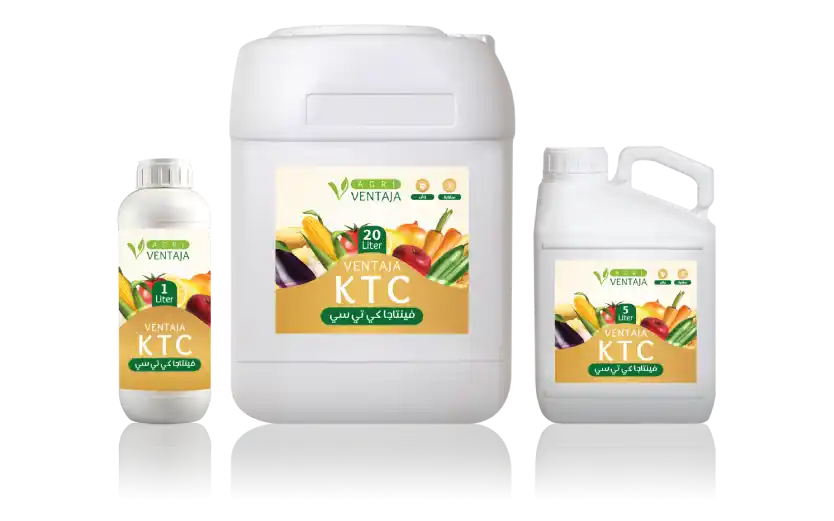
Ventaja® KTC
1 L / 5 L / 20 LVentaja® KTC supplies 36% potassium together with a 50% organic fraction. The organic component is not an additive but a structural part of the formulation: it conditions the root zone, raises cation exchange capacity locally, and complexes nutrients into forms that resist fixation. Delivery is carried by PhytoCarrier transport technology.
Analysis
| Potassium (K₂O) | 36% |
|---|---|
| Organic matter | 50% |
Properties
- pH: 7.0–8.0
- Density: 1.45 g/cm³
- EC mS: 1.0
- Sol (g/L): 100%
- Rates are guidelines; adjust to crop stage and local practice. Jar test before mixing.
Packing
1 L / 5 L / 20 L
Crops and Application Rates
| Crop | Fertigation rate | Foliar rate | Timing / growth stage |
|---|---|---|---|
| Vegetables | 15–25 L/ha | 2–3 L/ha | Fruit sizing and development |
| Fruit trees | 20–30 L/ha | 3–4 L/ha | From fruit set to maturity |
| Grapes | 15–25 L/ha | 2–3 L/ha | After fruit set |
| Field crops | 15–20 L/ha | — | Reproductive stages |
Benefits
Agronomic Benefits
- Larger, better-coloured fruit with improved taste and soluble solids content
- Improved resilience to drought and water stress through potassium-regulated stomatal control
- Higher retention of applied potassium in the root zone, reducing leaching loss
- Improved availability of soil-held elements through reduced local alkalinity
Commercial Advantages
- Potassium nutrition and organic soil conditioning in one product — the organic fraction is declared, not implied
- Complete solubility with no residue — protects drippers, filters and spray equipment
- Chelated micronutrients included — no separate corrective inputs required
- Complete dispersion in water at the point of use, with viscosity controlled for accurate dosing
- Compatible with standard fertigation and foliar programmes
Composition and Nutrient System
Composition and Nutrient System
- 36% K₂O from a chloride-free source, fully solubilised
- 50% organic fraction, declared and quantified rather than described in general terms
- The organic component raises local cation exchange capacity, holding potassium against leaching and releasing it to the root on demand
- Mild acidification of the root zone increases the proportion of soil-held elements that are available for uptake
Technology and mode of action
PhytoCarrier Transport Technology
- Nutrient transport system combining natural carrier molecules with an integrated organic fraction
- Enhances penetration through the leaf cuticle and across root membranes, raising uptake efficiency by both foliar and root routes
- Binds and escorts nutrients to the point of metabolism, so a higher proportion of the applied rate is actually absorbed
- Provides osmotic protection under heat and salinity stress, and conditions the root zone to stimulate microbial activity and lateral root development
Mode of Action
- Potassium regulates phloem sugar loading, cell turgor and the enzyme systems governing fruit sizing, firmness and shelf life
- It is the element most directly associated with resilience to drought and water stress, through its role in stomatal regulation
- It also contributes to resistance against fungal infection by maintaining cell wall integrity and reducing tissue exudates
Function of the Organic Fraction
- The organic fraction is declared as organic matter, organic carbon and organic nitrogen, so its contribution is quantified rather than implied
- Organic carbon serves as an energy substrate for beneficial rhizosphere microorganisms, raising biological activity around the root
- Organic nitrogen is released gradually through microbial mineralisation, extending supply relative to a mineral source alone
Chelation and Micronutrient Protection
- Micronutrients are held in chelated and complexed form, protecting them against precipitation before they reach the plant
- In alkaline irrigation water and in the presence of phosphate, non-chelated iron, zinc, manganese and copper precipitate within minutes and are lost from availability
- An integrated stabilizing fraction protects the chelated metals against oxidative degradation, maintaining them in the form the plant absorbs
Solubility in Use and Physical Consistency
- The operative specification is complete dispersion in water at the point of use — solubility in the tank, not appearance in the container
- Partial settling can occur in any concentrated suspension during storage. The product is shaken before use, which restores full homogeneity and does not affect the delivered analysis
- A controlled rheology system governs viscosity, allowing accurate dosing and clean transfer through injection equipment
- A stabilizing component protects the formulation against microbial degradation throughout storage
Application, compatibility and storage
Application and Compatibility
- Shake well before use
- Fertigation via drip and micro-irrigation; compatible with all injection equipment, hydroponic, NFT and substrate systems
- Foliar application at the recommended dilution
- Suitable for all agricultural soil types
- Mixable with most fertilizers and pesticides; a small-scale compatibility test is recommended before tank-mixing
- Storage: 7–30°C, away from direct sunlight; keep containers sealed
Ventaja®Amino 48% ASpecialty fertilizers
Free L-Amino Acid Liquid with Declared Organic Nitrogen
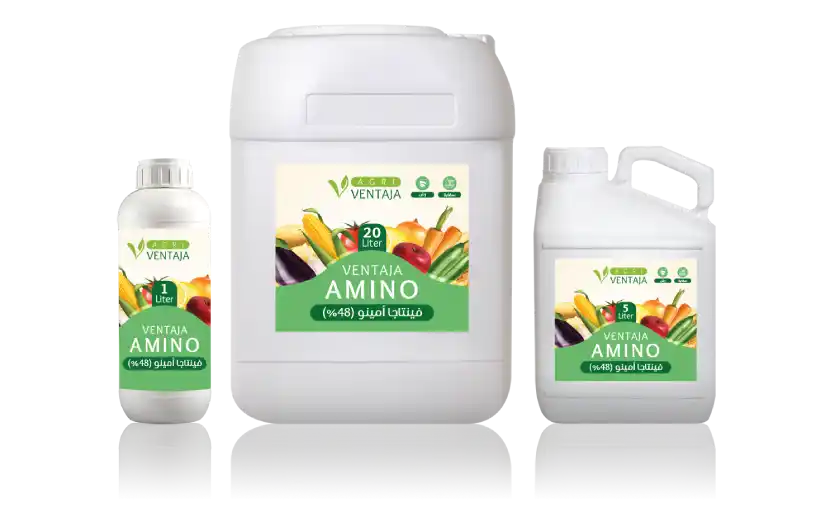
Ventaja® Amino 48% A
1 L / 5 L / 20 LVentaja® Amino 48% A supplies 48% free amino acids with 7.68% organic nitrogen. The amino acids are supplied in the free L-form, which is the configuration plant transport proteins recognise and absorb; protein-bound sources must first be hydrolysed by the plant, which consumes energy and delays availability. Delivery is carried by PhytoCarrier transport technology.
Analysis
| Total Amino Acids | 48% |
|---|---|
| Organic Nitrogen | 7.68% |
Properties
- pH: 3.5–5.0
- Density: 1.10 g/cm³
- EC mS: 0.9
- Sol (g/L): 100%
- Rates are guidelines; adjust to crop stage and local practice. Jar test before mixing.
Packing
1 L / 5 L / 20 L
Crops and Application Rates
| Crop | Fertigation rate | Foliar rate | Timing / growth stage |
|---|---|---|---|
| Vegetables | 3–5 L/ha | 1.5–2.5 L/ha | At transplanting and stress periods |
| Fruit trees | 5–8 L/ha | 2–3 L/ha | Flowering, fruit set and stress recovery |
| Field crops | 4–6 L/ha | 2–3 L/ha | Active growth and stress events |
| Ornamentals | 2–4 L/ha | 1–2 L/ha | Throughout the growing cycle |
Benefits
Agronomic Benefits
- Recovery of growth following heat, drought, salinity and transplant stress
- Improved nitrogen use efficiency, since applied nitrogen requires less metabolic processing
- Increased chlorophyll content and leaf colour
- Improved micronutrient availability through the chelating fraction
- Accelerated root development and improved fruit set
Commercial Advantages
- Free L-form amino acids — absorbed without the hydrolysis step protein-bound sources require
- Complete solubility with no residue — protects drippers, filters and spray equipment
- Chelated micronutrients included — no separate corrective inputs required
- Complete dispersion in water at the point of use, with viscosity controlled for accurate dosing
- Compatible with standard fertigation and foliar programmes
Composition and Nutrient System
Composition and Nutrient System
- 48% free amino acids in the L-configuration — absorbed directly without a hydrolysis step
- 7.68% organic nitrogen, declared and quantified as part of the analysis
- A multi-spectrum amino profile covering structural, enzymatic, osmotic and hormone-precursor roles
- A complexing fraction that chelates iron, zinc, manganese and copper, improving micronutrient availability
Technology and mode of action
PhytoCarrier Transport Technology
- Nutrient transport system combining natural carrier molecules with an integrated organic fraction
- Enhances penetration through the leaf cuticle and across root membranes, raising uptake efficiency by both foliar and root routes
- Binds and escorts nutrients to the point of metabolism, so a higher proportion of the applied rate is actually absorbed
- Provides osmotic protection under heat and salinity stress, and conditions the root zone to stimulate microbial activity and lateral root development
Mode of Action
- Amino acids applied in the free form are incorporated directly into protein synthesis, bypassing the energy cost of assimilating mineral nitrogen into an amino skeleton
- Specific residues carry distinct functions: some feed chlorophyll synthesis, others drive nitrogen transport within the plant
- Proline accumulates under heat, drought and salinity stress, where it stabilises membranes and cell proteins through osmotic adjustment
Organic Nitrogen and Chelating Function
- The organic fraction is declared as organic matter, organic carbon and organic nitrogen, so its contribution is quantified rather than implied
- Organic carbon serves as an energy substrate for beneficial rhizosphere microorganisms, raising biological activity around the root
- The amino fraction also acts as a natural chelating agent, complexing transition metals and holding them in plant-available form
Chelation and Micronutrient Protection
- Micronutrients are held in chelated and complexed form, protecting them against precipitation before they reach the plant
- In alkaline irrigation water and in the presence of phosphate, non-chelated iron, zinc, manganese and copper precipitate within minutes and are lost from availability
- An integrated stabilizing fraction protects the chelated metals against oxidative degradation, maintaining them in the form the plant absorbs
Solubility in Use and Physical Consistency
- The operative specification is complete dispersion in water at the point of use — solubility in the tank, not appearance in the container
- Partial settling can occur in any concentrated suspension during storage. The product is shaken before use, which restores full homogeneity and does not affect the delivered analysis
- A stabilizing component protects the formulation against microbial degradation during storage
- A controlled rheology system governs viscosity, allowing accurate dosing and clean transfer through injection equipment
Application, compatibility and storage
Application and Compatibility
- Shake well before use
- Fertigation via drip and micro-irrigation; compatible with all injection equipment, hydroponic, NFT and substrate systems
- Foliar application at the recommended dilution
- Suitable for all agricultural soil types
- Mixable with most fertilizers and pesticides; a small-scale compatibility test is recommended before tank-mixing
- Storage: 7–30°C, away from direct sunlight; keep containers sealed
Ventaja®BioSea 0-15-0Specialty fertilizers
Phosphorus with Marine Extract, Boron and Zinc
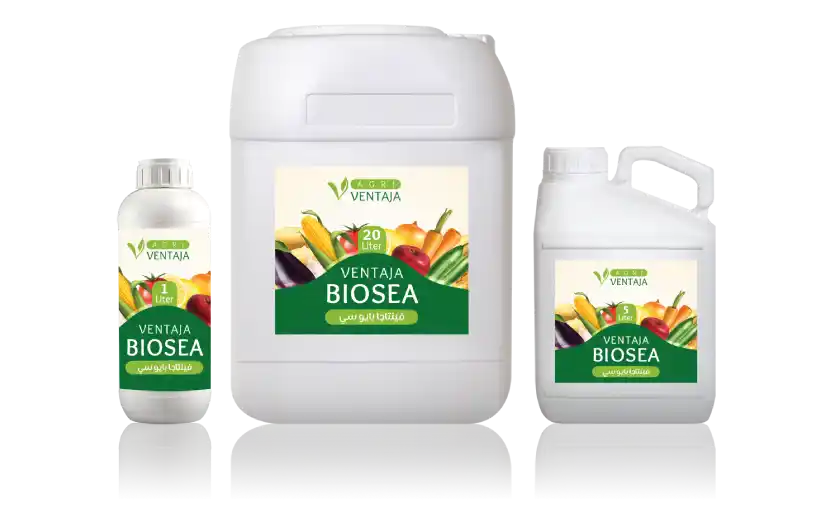
Ventaja® BioSea 0-15-0
1 L / 5 L / 20 LVentaja® BioSea 0-15-0 combines 15% phosphorus with a 10% marine extract fraction, 8% boron, 2% zinc and 10% amino acids. The phosphorus fraction is manufactured from purified, gypsum-free phosphoric acid, and is supplied as immediately available orthophosphate. Delivery is carried by PhytoCarrier transport technology.
Analysis
| Phosphorus (P₂O₅) | 15% |
|---|---|
| Seaweed | 10% |
| Boron (B₂O₃) | 8% |
| Zinc (Zn) | 2% |
| Amino Acids | 10% |
Properties
- pH: 2.5
- Density: 1.30 g/cm³
- EC mS: 0.45
- Sol (g/L): 100%
- Rates are guidelines; adjust to crop stage and local practice. Jar test before mixing.
Packing
1 L / 5 L / 20 L
Crops and Application Rates
| Crop | Fertigation rate | Foliar rate | Timing / growth stage |
|---|---|---|---|
| Vegetables | 3–5 L/ha | 1.5–2 L/ha | At transplanting and pre-flowering |
| Fruit trees | 5–7 L/ha | 2–3 L/ha | Root development and fruit set |
| Vines & strawberries | 4–6 L/ha | 1.5–2.5 L/ha | Establishment and flowering |
| Cereals | 3–5 L/ha | 1.5–2 L/ha | Early growth and tillering |
Benefits
Agronomic Benefits
- Accelerated root development: branching, surface area and depth
- Improved flower initiation and fruit-set percentage
- Improved sugar translocation and soluble solids content
- Faster recovery following transplanting and stress events
- Recovery of phosphorus previously fixed and unavailable in the soil
Commercial Advantages
- Purified, gypsum-free phosphorus source — no insoluble sulphate fraction entering the irrigation system
- Complete solubility with no residue — protects drippers, filters and spray equipment
- Chelated micronutrients included — no separate corrective inputs required
- Complete dispersion in water at the point of use, with viscosity controlled for accurate dosing
- Compatible with standard fertigation and foliar programmes
Composition and Nutrient System
Composition and Nutrient System
- 15% P₂O₅ as immediately available orthophosphate from a purified, gypsum-free source
- 10% marine extract and 10% amino acids, declared and quantified as part of the analysis
- 8% boron and 2% zinc in chelated form, supporting pollen viability and growth-hormone synthesis
- A wetting and penetration system giving complete foliar coverage at the recommended dilution
Technology and mode of action
PhytoCarrier Transport Technology
- Nutrient transport system combining natural carrier molecules with an integrated organic fraction
- Enhances penetration through the leaf cuticle and across root membranes, raising uptake efficiency by both foliar and root routes
- Binds and escorts nutrients to the point of metabolism, so a higher proportion of the applied rate is actually absorbed
- Provides osmotic protection under heat and salinity stress, and conditions the root zone to stimulate microbial activity and lateral root development
Mode of Action
- Phosphorus funds ATP-dependent energy transfer, root-tip cell division and the signalling that governs flower initiation
- It is supplied as orthophosphate, the only form absorbed directly without further metabolic conversion, and the acidic reaction releases part of the soil's fixed phosphorus reserve
- The marine extract fraction contributes natural growth-regulating compounds that stimulate root proliferation and assist recovery after stress
Boron, Zinc and the Organic Fraction
- Boron is required for pollen tube elongation and fertilisation, and forms the complexes that transport sugars through the phloem
- Zinc is required for synthesis of the principal plant growth hormone, which regulates cell division in developing tissue
- The amino fraction acts as a natural chelating agent, holding the micronutrients in plant-available form and improving their translocation
Purity of the Phosphorus Source
- The phosphorus fraction is manufactured from purified phosphoric acid rather than crude acid
- Crude acid carries calcium sulphate (gypsum), which precipitates in the tank and in irrigation lines and forms the sediment that blocks drippers, filters and spray nozzles
- The purified source is gypsum-free: it dissolves completely, produces a clear solution and leaves no residue in the system
- The absence of insoluble sulphate results in a clear solution and eliminates the sediment load carried into the irrigation system
Solubility in Use and Physical Consistency
- The operative specification is complete dispersion in water at the point of use — solubility in the tank, not appearance in the container
- Partial settling can occur in any concentrated suspension during storage. The product is shaken before use, which restores full homogeneity and does not affect the delivered analysis
- A stabilizing component protects the formulation against microbial degradation during storage
- A controlled rheology system governs viscosity, allowing accurate dosing and clean transfer through injection equipment
Application, compatibility and storage
Application and Compatibility
- Shake well before use
- Fertigation via drip and micro-irrigation; compatible with all injection equipment, hydroponic, NFT and substrate systems
- Foliar application at the recommended dilution
- Suitable for all agricultural soil types
- Mixable with most fertilizers and pesticides; a small-scale compatibility test is recommended before tank-mixing
- Storage: 7–30°C, away from direct sunlight; keep containers sealed
Ventaja®Humic Acid 15%Specialty fertilizers
Liquid Humic and Fulvic Acid Soil Conditioner
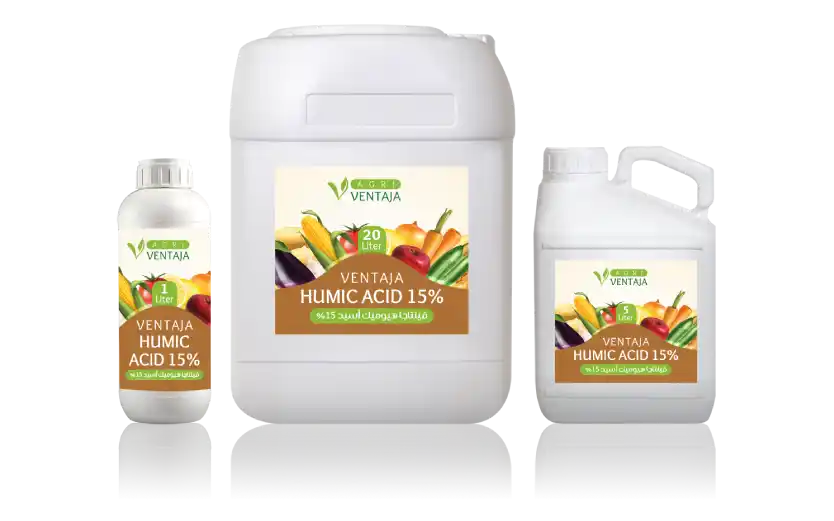
Ventaja® Humic Acid 15%
1 L / 5 L / 20 LVentaja® Humic Acid 15% is a liquid soil conditioner supplying 15% combined humic and fulvic acids. It does not supply a nutrient directly: it changes the capacity of the soil to hold, exchange and release nutrients, and the capacity of the root system to acquire them. Its effect is therefore expressed across the whole fertilisation programme rather than in a single element.
Analysis
| Humic & Fulvic Acid | 15% |
|---|
Properties
- pH: 8.5–9.5
- Density: 1.10 g/cm³
- EC mS: 0.4
- Sol (g/L): 100%
- Rates are guidelines; adjust to crop stage and local practice. Jar test before mixing.
Packing
1 L / 5 L / 20 L
Crops and Application Rates
| Crop | Application rate | Timing / growth stage |
|---|---|---|
| Vegetables | 10–20 L/ha | During vegetative growth |
| Fruit trees | 15–25 L/ha | Throughout the growing cycle |
| Field crops | 10–15 L/ha | Early growth stages |
Benefits
Agronomic Benefits
- Improved soil structure, aeration and water infiltration
- Higher retention and availability of applied nutrients, reducing loss below the root zone
- Increased root proliferation, branching and root-hair density
- Improved germination, establishment and recovery after stress
Commercial Advantages
- Raises the efficiency of the whole fertilisation programme rather than supplying a single nutrient
- Complete solubility with no residue — protects drippers, filters and spray equipment
- Chelated micronutrients included — no separate corrective inputs required
- Complete dispersion in water at the point of use, with viscosity controlled for accurate dosing
- Compatible with standard fertigation and foliar programmes
Composition and Nutrient System
Composition and Nutrient System
- 15% combined humic and fulvic acids, declared and quantified rather than described in general terms
- The two fractions act in different places: humic acids condition the soil, fulvic acids carry nutrients into root tissue
- Fulvic acids remain soluble across the entire pH range, so the carrier function operates in both acid and alkaline soils
- Compatible with most fertilizers and pesticides, raising the efficiency of the programme they are applied within
Technology and mode of action
PhytoCarrier Transport Technology
- Nutrient transport system combining natural carrier molecules with an integrated organic fraction
- Enhances penetration through the leaf cuticle and across root membranes, raising uptake efficiency by both foliar and root routes
- Binds and escorts nutrients to the point of metabolism, so a higher proportion of the applied rate is actually absorbed
- Provides osmotic protection under heat and salinity stress, and conditions the root zone to stimulate microbial activity and lateral root development
Mode of Action
- Cation exchange capacity: humic substances carry an exchange capacity several times that of clay minerals, holding potassium, calcium, magnesium and ammonium against leaching
- Aggregation: they bind soil particles into stable aggregates, improving aeration, water infiltration and root penetration
- Water retention: the humic fraction holds many times its own weight in water, raising the water-holding capacity of light and sandy soils
The Humic and Fulvic Distinction
- Humic acids are higher in molecular weight and function primarily within the soil: aggregation, exchange capacity and water retention
- Fulvic acids are lower in molecular weight and remain soluble at all pH values; their size allows them to enter root tissue while carrying a complexed nutrient
- Both fractions complex iron, zinc, manganese and copper, maintaining them in available form rather than allowing precipitation
Chelation and Micronutrient Protection
- Micronutrients are held in chelated and complexed form, protecting them against precipitation before they reach the plant
- In alkaline irrigation water and in the presence of phosphate, non-chelated iron, zinc, manganese and copper precipitate within minutes and are lost from availability
- An integrated stabilizing fraction protects the chelated metals against oxidative degradation, maintaining them in the form the plant absorbs
Solubility in Use and Physical Consistency
- The operative specification is complete dispersion in water at the point of use — solubility in the tank, not appearance in the container
- Partial settling can occur in any concentrated suspension during storage. The product is shaken before use, which restores full homogeneity and does not affect the delivered analysis
- A stabilizing component protects the formulation against microbial degradation during storage
- A controlled rheology system governs viscosity, allowing accurate dosing and clean transfer through injection equipment
Application, compatibility and storage
Application and Compatibility
- Shake well before use
- Fertigation via drip and micro-irrigation; compatible with all injection equipment, hydroponic, NFT and substrate systems
- Foliar application at the recommended dilution
- Suitable for all agricultural soil types
- Mixable with most fertilizers and pesticides; a small-scale compatibility test is recommended before tank-mixing
- Storage: 7–30°C, away from direct sunlight; keep containers sealed
Ventaja®SeaweedSpecialty fertilizers
Marine Extract Bio-Stimulant with Declared Organic Fraction
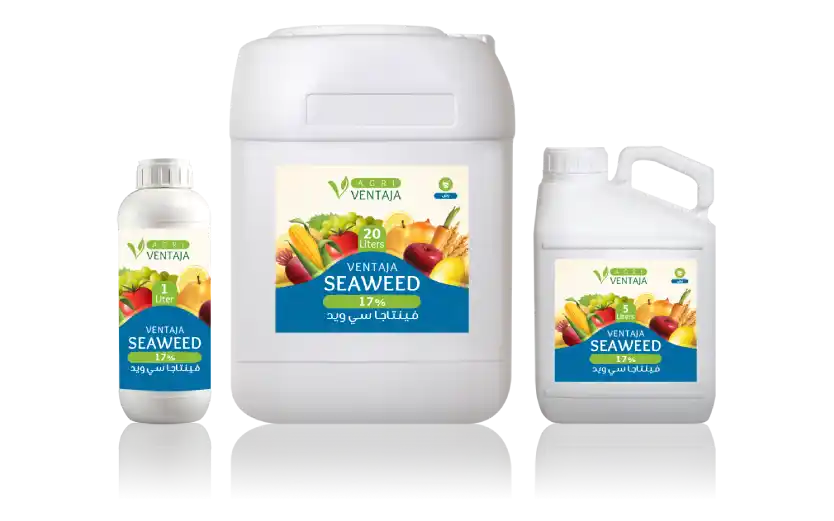
Ventaja® Seaweed
1 L / 5 L / 20 LVentaja® Seaweed is a liquid bio-stimulant based on a 10% marine extract fraction. Marine extracts supply naturally occurring growth-regulating compounds together with betaines, polysaccharides and trace elements. Their agronomic value lies in modifying the plant's response to stress rather than in supplying a nutrient: the compounds act on signalling and osmotic adjustment, not on nutrient balance.
Analysis
| Seaweed extract | 10% |
|---|
Properties
- pH: 6.0–7.0
- Density: 1.17 g/cm³
- EC mS: 0.15
- Sol (g/L): 100%
- Rates are guidelines; adjust to crop stage and local practice. Jar test before mixing.
Packing
1 L / 5 L / 20 L
Crops and Application Rates
| Crop | Application rate | Timing / growth stage |
|---|---|---|
| Fruit trees, citrus, grape, olive | 1–1.5 L/ha | Throughout the growing cycle |
| Vegetables | 1–1.5 L/ha | Vegetative and fruiting stages |
| Field crops | 1–1.5 L/ha | During active growth |
Benefits
Agronomic Benefits
- Faster resumption of growth following heat, drought, salinity and transplant stress
- Increased chlorophyll content and photosynthetic activity
- Improved root initiation and establishment of transplanted material
- Improved trace element availability through the chelating fraction
Commercial Advantages
- Acts on stress response, not on nutrient balance — complements rather than replaces the mineral programme
- Complete solubility with no residue — protects drippers, filters and spray equipment
- Chelated micronutrients included — no separate corrective inputs required
- Complete dispersion in water at the point of use, with viscosity controlled for accurate dosing
- Compatible with standard fertigation and foliar programmes
Composition and Nutrient System
Composition and Nutrient System
- 10% marine extract, declared and quantified rather than described in general terms
- Supplies naturally occurring growth-regulating compounds together with betaines, polysaccharides and trace elements
- A wetting fraction giving complete and even coverage of the leaf surface at the recommended dilution
- Compatible with standard fertigation and foliar programmes, acting alongside rather than in place of mineral nutrition
Technology and mode of action
PhytoCarrier Transport Technology
- Nutrient transport system combining natural carrier molecules with an integrated organic fraction
- Enhances penetration through the leaf cuticle and across root membranes, raising uptake efficiency by both foliar and root routes
- Binds and escorts nutrients to the point of metabolism, so a higher proportion of the applied rate is actually absorbed
- Provides osmotic protection under heat and salinity stress, and conditions the root zone to stimulate microbial activity and lateral root development
Mode of Action
- The extract contributes compounds with growth-regulating activity, which act on cell division, root initiation and the balance between vegetative and reproductive development
- Betaines function as osmotic protectants: they accumulate in the cytoplasm and stabilise proteins and membranes when water potential falls under drought, salinity or heat
- Polysaccharide fractions contribute chelating capacity, holding trace elements in forms that resist precipitation in the root zone
Function Under Stress Conditions
- Under stress the limitation is not usually nutrient supply but the plant's capacity to maintain metabolic function while water potential and cell chemistry are disturbed
- Osmotic protectants allow photosynthesis and enzyme activity to continue at lower water potential than would otherwise be tolerated
- This is why the response to a bio-stimulant is most visible in the period following a stress event rather than under favourable conditions
Chelation and Micronutrient Protection
- Micronutrients are held in chelated and complexed form, protecting them against precipitation before they reach the plant
- In alkaline irrigation water and in the presence of phosphate, non-chelated iron, zinc, manganese and copper precipitate within minutes and are lost from availability
- An integrated stabilizing fraction protects the chelated metals against oxidative degradation, maintaining them in the form the plant absorbs
Solubility in Use and Physical Consistency
- The operative specification is complete dispersion in water at the point of use — solubility in the tank, not appearance in the container
- Partial settling can occur in any concentrated suspension during storage. The product is shaken before use, which restores full homogeneity and does not affect the delivered analysis
- A controlled rheology system governs viscosity, allowing accurate dosing and clean transfer through injection equipment
- A stabilizing component protects the formulation against microbial degradation throughout storage
Application, compatibility and storage
Application and Compatibility
- Shake well before use
- Fertigation via drip and micro-irrigation; compatible with all injection equipment, hydroponic, NFT and substrate systems
- Foliar application at the recommended dilution
- Suitable for all agricultural soil types
- Mixable with most fertilizers and pesticides; a small-scale compatibility test is recommended before tank-mixing
- Storage: 7–30°C, away from direct sunlight; keep containers sealed
Ventaja®RootivaSpecialty fertilizers
Phosphorus–Calcium–Boron Liquid with Amino Carrier

Ventaja® Rootiva
1 L / 5 L / 20 LVentaja® Rootiva supplies 25% phosphorus, 5% calcium and 0.1% boron with a 5% amino fraction. Supplying phosphorus and calcium in the same product is technically demanding, since the two precipitate readily as insoluble calcium phosphate. The formulation holds both in solution simultaneously, and the phosphorus fraction is manufactured from purified, gypsum-free phosphoric acid.
Analysis
| Phosphorus (P₂O₅) | 25% |
|---|---|
| Calcium Oxide (CaO) | 5% |
| Boron (B) | 0.1% |
| Amino Acid | 5% |
Properties
- pH: 2.0
- Density: 1.28 g/cm³
- EC mS: 1.2
- Sol (g/L): 100%
- Rates are guidelines; adjust to crop stage and local practice. Jar test before mixing.
Packing
1 L / 5 L / 20 L
Crops and Application Rates
| Crop | Fertigation rate | Foliar rate | Timing / growth stage |
|---|---|---|---|
| Vegetables | 3–5 L/ha | 1.5–2 L/ha | Early growth and flowering |
| Fruit trees | 5–7 L/ha | 2–3 L/ha | Flowering and fruit development |
| Field crops | 3–5 L/ha | 1.5–2 L/ha | Establishment and reproductive stages |
Benefits
Agronomic Benefits
- Increased root length, branching and absorbing surface area
- Improved flower initiation and fruit-set percentage
- Improved tissue firmness through calcium delivered alongside phosphorus
- Faster establishment following planting and transplanting
Commercial Advantages
- Phosphorus and calcium in one product — a combination that normally requires two separate applications
- Complete solubility with no residue — protects drippers, filters and spray equipment
- Chelated micronutrients included — no separate corrective inputs required
- Complete dispersion in water at the point of use, with viscosity controlled for accurate dosing
- Compatible with standard fertigation and foliar programmes
Composition and Nutrient System
Composition and Nutrient System
- 25% phosphorus and 5% calcium held in solution simultaneously — a combination that precipitates readily in an unstabilised formulation
- Phosphorus supplied as orthophosphate from a purified, gypsum-free source
- 0.1% boron at the proportion required to support calcium movement into developing tissue
- A 5% amino fraction acting as a complexing agent and improving uptake of all three elements
Technology and mode of action
PhytoCarrier Transport Technology
- Nutrient transport system combining natural carrier molecules with an integrated organic fraction
- Enhances penetration through the leaf cuticle and across root membranes, raising uptake efficiency by both foliar and root routes
- Binds and escorts nutrients to the point of metabolism, so a higher proportion of the applied rate is actually absorbed
- Provides osmotic protection under heat and salinity stress, and conditions the root zone to stimulate microbial activity and lateral root development
Mode of Action
- Phosphorus funds the ATP-dependent energy transfer that pays for cell division at the root tip and for flower initiation
- It drives root architecture — length, branching and the fine root hairs that perform the actual absorption
- It is supplied as orthophosphate, the only form absorbed directly without further metabolic conversion
Holding Calcium and Phosphorus Together
- Calcium and phosphate ions combine readily to form insoluble calcium phosphate; in an unstabilised mixture this precipitates in the tank and both elements are lost
- The complexing fraction binds the calcium, preventing it from reacting with the phosphate while both remain available to the plant
- Boron is required for the movement of calcium into developing tissue; without it, absorbed calcium is poorly delivered to where it is structurally needed
Purity of the Phosphorus Source
- The phosphorus fraction is manufactured from purified phosphoric acid rather than crude acid
- Crude acid carries calcium sulphate (gypsum), which precipitates in the tank and in irrigation lines and forms the sediment that blocks drippers, filters and spray nozzles
- The purified source is gypsum-free: it dissolves completely, produces a clear solution and leaves no residue in the system
- The absence of insoluble sulphate results in a clear solution and eliminates the sediment load carried into the irrigation system
Solubility in Use and Physical Consistency
- The operative specification is complete dispersion in water at the point of use — solubility in the tank, not appearance in the container
- Partial settling can occur in any concentrated suspension during storage. The product is shaken before use, which restores full homogeneity and does not affect the delivered analysis
- A controlled rheology system governs viscosity, allowing accurate dosing and clean transfer through injection equipment
- A stabilizing component protects the formulation against microbial degradation throughout storage
Application, compatibility and storage
Application and Compatibility
- Shake well before use
- Fertigation via drip and micro-irrigation; compatible with all injection equipment, hydroponic, NFT and substrate systems
- Foliar application at the recommended dilution
- Suitable for all agricultural soil types
- Mixable with most fertilizers and pesticides; a small-scale compatibility test is recommended before tank-mixing
- Storage: 7–30°C, away from direct sunlight; keep containers sealed
Ventaja®Potenza PKSpecialty fertilizers
High-Concentration Phosphorus–Potassium Liquid
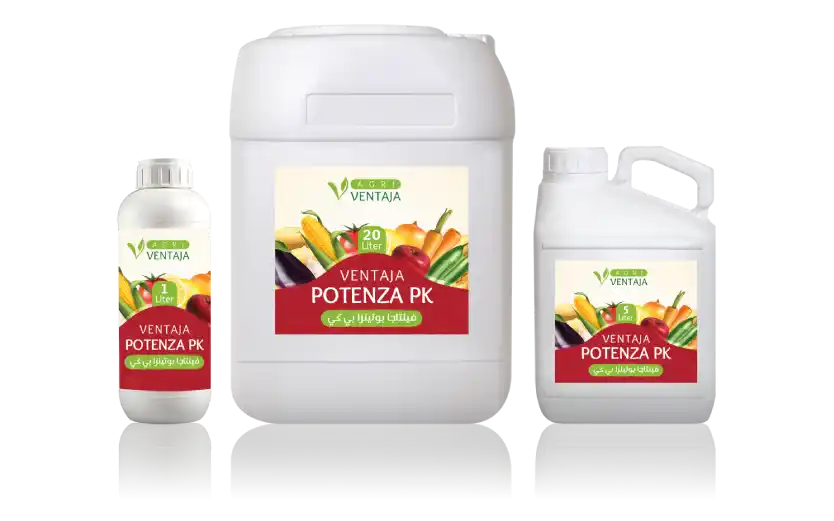
Ventaja® Potenza PK
1 L / 5 L / 20 LVentaja® Potenza PK supplies 45% phosphorus and 55% potassium — a combined nutrient load of 100% by volume with no nitrogen. It is formulated for the reproductive phase, where phosphorus drives flower initiation and potassium drives the fill that follows, and where nitrogen would direct the plant back toward vegetative growth. The phosphorus fraction is manufactured from purified, gypsum-free phosphoric acid.
Analysis
| Phosphorus (P₂O₅) | 45% |
|---|---|
| Potassium (K₂O) | 55% |
Properties
- pH: 8.5
- Density: 1.66 g/cm³
- EC mS: 0.04
- Sol (g/L): 25
- Rates are guidelines; adjust to crop stage and local practice. Jar test before mixing.
Packing
1 L / 5 L / 20 L
Crops and Application Rates
| Crop | Foliar rate | Fertigation rate | Timing / growth stage |
|---|---|---|---|
| Vegetables | 150–250 ml/100 L | 2–4 L/ha | Pre-flowering and fruit set |
| Fruit trees | 200–300 ml/100 L | 4–6 L/ha | Flowering and fruit set |
| Grapes | 150–250 ml/100 L | 3–5 L/ha | After fruit set |
Benefits
Agronomic Benefits
- More uniform and abundant flower initiation
- Improved fruit-set percentage with reduced physiological drop
- Improved fruit sizing, firmness and soluble solids content
- Recovery of phosphorus previously fixed and unavailable in the soil
Commercial Advantages
- 100% combined nutrient load with no nitrogen — maximum reproductive effect from minimum applied volume
- Complete solubility with no residue — protects drippers, filters and spray equipment
- Chelated micronutrients included — no separate corrective inputs required
- Complete dispersion in water at the point of use, with viscosity controlled for accurate dosing
- Compatible with standard fertigation and foliar programmes
Composition and Nutrient System
Composition and Nutrient System
- 45% P₂O₅ and 55% K₂O — a combined nutrient load of 100% by volume
- Nitrogen-free, removing the vegetative signal during the reproductive transition
- Phosphorus supplied as orthophosphate from a purified, gypsum-free source
- High concentration reduces application volume, handling and osmotic load per unit of nutrient delivered
Technology and mode of action
PhytoCarrier Transport Technology
- Nutrient transport system combining natural carrier molecules built into the formulation
- Enhances penetration through the leaf cuticle and across root membranes, raising uptake efficiency by both foliar and root routes
- Binds and escorts nutrients to the point of metabolism, so a higher proportion of the applied rate is actually absorbed
- Provides osmotic protection under heat and salinity stress
Mode of Action
- Phosphorus supplies the ATP-dependent energy transfer that funds flower initiation and the cell divisions of early fruit development
- The acidic reaction additionally releases phosphorus fixed from previous applications, which remains chemically unavailable in calcareous soils
- It is supplied as orthophosphate — absorbed directly, with no conversion step in the soil
Potassium Function and Stage Coverage
- Potassium regulates phloem sugar loading, cell turgor and the enzyme systems governing fruit size, firmness and shelf life
- Supplying both elements in one product removes the timing risk associated with switching grades between flower initiation and fruit fill
- The absence of nitrogen allows the reproductive signal to operate without competition from vegetative extension
Purity of the Phosphorus Source
- The phosphorus fraction is manufactured from purified phosphoric acid rather than crude acid
- Crude acid carries calcium sulphate (gypsum), which precipitates in the tank and in irrigation lines and forms the sediment that blocks drippers, filters and spray nozzles
- The purified source is gypsum-free: it dissolves completely, produces a clear solution and leaves no residue in the system
- The absence of insoluble sulphate results in a clear solution and eliminates the sediment load carried into the irrigation system
Solubility in Use and Physical Consistency
- The operative specification is complete dispersion in water at the point of use — solubility in the tank, not appearance in the container
- Partial settling can occur in any concentrated suspension during storage. The product is shaken before use, which restores full homogeneity and does not affect the delivered analysis
- A controlled rheology system governs viscosity, allowing accurate dosing and clean transfer through injection equipment
- A stabilizing component protects the formulation against microbial degradation throughout storage
Application, compatibility and storage
Application and Compatibility
- Shake well before use
- Fertigation via drip and micro-irrigation; compatible with all injection equipment, hydroponic, NFT and substrate systems
- Foliar application at the recommended dilution
- Suitable for all agricultural soil types
- Mixable with most fertilizers and pesticides; a small-scale compatibility test is recommended before tank-mixing
- Storage: 7–30°C, away from direct sunlight; keep containers sealed
Ventaja®N 40-0-0Specialty fertilizers
Liquid Nitrogen in Multiple Forms
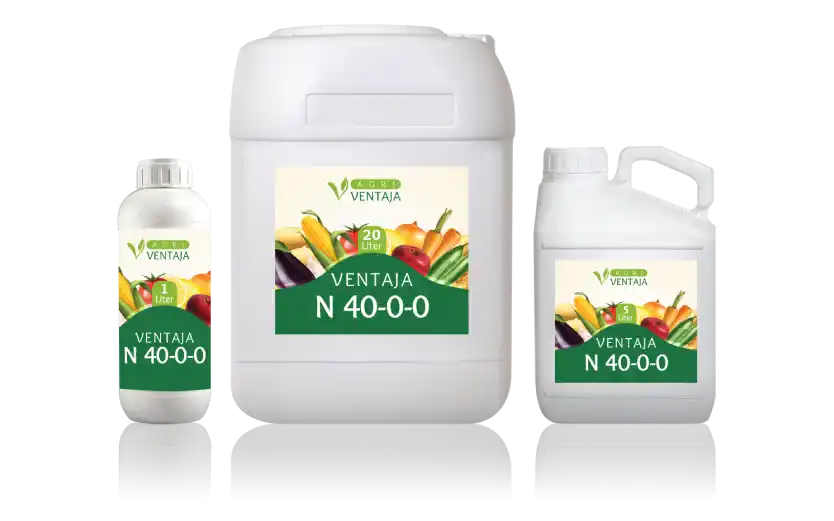
Ventaja® N 40-0-0
1 L / 5 L / 20 LVentaja® N 40-0-0 is a pure liquid nitrogen source supplying 40% total nitrogen in multiple forms. The forms differ in absorption timescale, which is what allows a loading of this magnitude to be applied as a continuous supply rather than a single peak. Delivery is carried by PhytoCarrier transport technology.
Analysis
| Total Nitrogen (N) | 40% |
|---|---|
| Nitric Nitrogen | 11% |
| Ammonium Nitrogen | 11% |
| Ureic | 18% |
Properties
- pH: 5.0–6.0
- Density: 1.36 g/cm³
- EC mS: 1.0
- Sol (g/L): 400
- Rates are guidelines; adjust to crop stage and local practice. Jar test before mixing.
Packing
1 L / 5 L / 20 L
Crops and Application Rates
| Crop | Fertigation rate | Foliar rate | Timing / growth stage |
|---|---|---|---|
| Vegetables | 15–25 L/ha | 2–3 L/ha | During vegetative growth |
| Fruit trees | 20–30 L/ha | 3–4 L/ha | Active growth stages |
| Field crops | 15–25 L/ha | — | Vegetative development |
Benefits
Agronomic Benefits
- Rapid canopy establishment and expansion of leaf area
- Deeper and more uniform leaf colour
- Faster recovery following transplanting, cold or heat stress
- Reduced leaching loss relative to a single-form nitrogen source
Commercial Advantages
- Nitrogen dosed independently — the rate can be matched to growth stage instead of fixed by a blended analysis
- Complete solubility with no residue — protects drippers, filters and spray equipment
- Chelated micronutrients included — no separate corrective inputs required
- Complete dispersion in water at the point of use, with viscosity controlled for accurate dosing
- Compatible with standard fertigation and foliar programmes
Composition and Nutrient System
Composition and Nutrient System
- 40% total nitrogen — the highest nitrogen concentration in the Ventaja liquid range
- Supplied in multiple forms with different absorption timescales, giving continuous availability rather than a single peak
- Phosphorus-free and potassium-free, allowing nitrogen to be dosed independently of the rest of the programme
- Fully soluble with no dissolution step, suitable for both fertigation and foliar routes
Technology and mode of action
PhytoCarrier Transport Technology
- Nutrient transport system combining natural carrier molecules with an integrated organic fraction
- Enhances penetration through the leaf cuticle and across root membranes, raising uptake efficiency by both foliar and root routes
- Binds and escorts nutrients to the point of metabolism, so a higher proportion of the applied rate is actually absorbed
- Provides osmotic protection under heat and salinity stress, and conditions the root zone to stimulate microbial activity and lateral root development
Mode of Action
- Nitrogen is the largest single constituent of the photosynthetic machinery: chlorophyll, the carbon-fixing enzymes and leaf protein
- Leaf area is the crop's production capacity — every unit of yield is funded by photosynthesis in tissue built earlier in the cycle
- Supplying nitrogen in more than one form spreads availability across the interval between irrigations, which reduces both leaching loss and the growth surge that follows a single concentrated dose
Dosing Discipline and Growth Stage
- A single-nutrient nitrogen source allows the rate to be matched to growth stage rather than fixed by a blended analysis
- Nitrogen requirement is highest during canopy building and lowest during ripening, where it delays colour development and reduces sugar accumulation
- This is why a nitrogen-only product is applied early and withdrawn as the crop enters the quality-formation phase
Chelation and Micronutrient Protection
- Micronutrients are held in chelated and complexed form, protecting them against precipitation before they reach the plant
- In alkaline irrigation water and in the presence of phosphate, non-chelated iron, zinc, manganese and copper precipitate within minutes and are lost from availability
- An integrated stabilizing fraction protects the chelated metals against oxidative degradation, maintaining them in the form the plant absorbs
Solubility in Use and Physical Consistency
- The operative specification is complete dispersion in water at the point of use — solubility in the tank, not appearance in the container
- Partial settling can occur in any concentrated suspension during storage. The product is shaken before use, which restores full homogeneity and does not affect the delivered analysis
- A controlled rheology system governs viscosity, allowing accurate dosing and clean transfer through injection equipment
- A stabilizing component protects the formulation against microbial degradation throughout storage
Application, compatibility and storage
Application and Compatibility
- Shake well before use
- Fertigation via drip and micro-irrigation; compatible with all injection equipment, hydroponic, NFT and substrate systems
- Foliar application at the recommended dilution
- Suitable for all agricultural soil types
- Mixable with most fertilizers and pesticides; a small-scale compatibility test is recommended before tank-mixing
- Storage: 7–30°C, away from direct sunlight; keep containers sealed
Ventaja®Fert 5-70-3Specialty fertilizers
High-Concentration Liquid Phosphorus
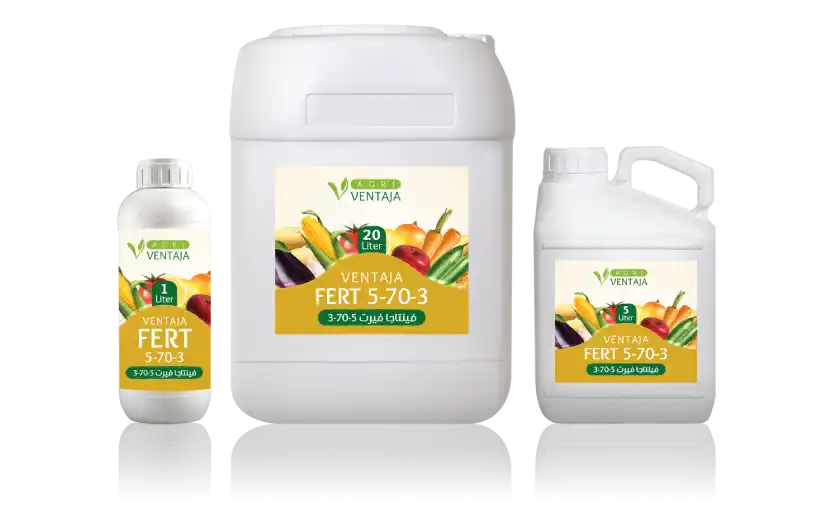
Ventaja® Fert 5-70-3
1 L / 5 L / 20 LVentaja® Fert 5-70-3 supplies 70% phosphorus, the highest phosphorus concentration in the liquid range, with nitrogen and potassium at maintenance level. It is manufactured from purified, gypsum-free phosphoric acid and its strongly acidic reaction performs a second function: it dissolves calcium scale within the irrigation system while it feeds.
Analysis
| Nitrogen (N) | 5% |
|---|---|
| Phosphorus (P₂O₅) | 70% |
| Potassium (K₂O) | 3% |
Properties
- pH: 1.5–3.0
- Density: 1.65 g/cm³
- EC mS: 1.8
- Sol (g/L): 100%
- Rates are guidelines; adjust to crop stage and local practice. Jar test before mixing.
Packing
1 L / 5 L / 20 L
Crops and Application Rates
| Crop | Fertigation rate | Foliar rate | Timing / growth stage |
|---|---|---|---|
| Vegetables | 10–20 L/ha | 1–2 L/ha | Rooting and flowering |
| Fruit trees | 15–25 L/ha | 2–3 L/ha | Early growth and flowering |
| Field crops | 10–20 L/ha | — | At establishment |
Benefits
Agronomic Benefits
- Increased root length, branching and absorbing surface area
- More uniform and abundant flower initiation
- Recovery of phosphorus previously fixed and unavailable in the soil
- Improved distribution uniformity through reduced emitter blockage
Commercial Advantages
- Feeds the crop and cleans the system in the same application
- Complete solubility with no residue — protects drippers, filters and spray equipment
- Chelated micronutrients included — no separate corrective inputs required
- Complete dispersion in water at the point of use, with viscosity controlled for accurate dosing
- Compatible with standard fertigation and foliar programmes
Composition and Nutrient System
Composition and Nutrient System
- 70% P₂O₅ — the highest phosphorus concentration in the Ventaja liquid range
- Manufactured from purified, gypsum-free phosphoric acid and supplied as directly absorbable orthophosphate
- Nitrogen and potassium held at maintenance level so neither competes with the phosphorus response
- Strongly acidic reaction dissolving calcium scale and suppressing biological build-up within the irrigation system
Technology and mode of action
PhytoCarrier Transport Technology
- Nutrient transport system combining natural carrier molecules built into the formulation
- Enhances penetration through the leaf cuticle and across root membranes, raising uptake efficiency by both foliar and root routes
- Binds and escorts nutrients to the point of metabolism, so a higher proportion of the applied rate is actually absorbed
- Provides osmotic protection under heat and salinity stress
Mode of Action
- Phosphorus is the least mobile major nutrient: a substantial proportion of any application is chemically fixed within days, by calcium in alkaline soils and by iron and aluminium in acid soils
- The effective dose is therefore always lower than the applied dose, and concentration together with delivery chemistry determines how much reaches the root
- The acidic reaction additionally releases phosphorus fixed from previous seasons, converting an unavailable soil reserve into available supply
Effect Within the Irrigation System
- The acidic reaction dissolves calcium and lime scale deposited in drippers, filters and lateral lines during application
- It suppresses the biological build-up that restricts flow in warm-season irrigation
- Reduced blockage improves distribution uniformity across the block, which affects the whole fertigation programme and not only this product
Purity of the Phosphorus Source
- The phosphorus fraction is manufactured from purified phosphoric acid rather than crude acid
- Crude acid carries calcium sulphate (gypsum), which precipitates in the tank and in irrigation lines and forms the sediment that blocks drippers, filters and spray nozzles
- The purified source is gypsum-free: it dissolves completely, produces a clear solution and leaves no residue in the system
- The absence of insoluble sulphate results in a clear solution and eliminates the sediment load carried into the irrigation system
Solubility in Use and Physical Consistency
- The operative specification is complete dispersion in water at the point of use — solubility in the tank, not appearance in the container
- Partial settling can occur in any concentrated suspension during storage. The product is shaken before use, which restores full homogeneity and does not affect the delivered analysis
- A controlled rheology system governs viscosity, allowing accurate dosing and clean transfer through injection equipment
- A stabilizing component protects the formulation against microbial degradation throughout storage
Application, compatibility and storage
Application and Compatibility
- Shake well before use
- Fertigation via drip and micro-irrigation; compatible with all injection equipment, hydroponic, NFT and substrate systems
- Foliar application at the recommended dilution
- Suitable for all agricultural soil types
- Mixable with most fertilizers and pesticides; a small-scale compatibility test is recommended before tank-mixing
- Storage: 7–30°C, away from direct sunlight; keep containers sealed
Ventaja®SalSpecialty fertilizers
Calcium with Organic Fraction for Sodium-Affected Soils
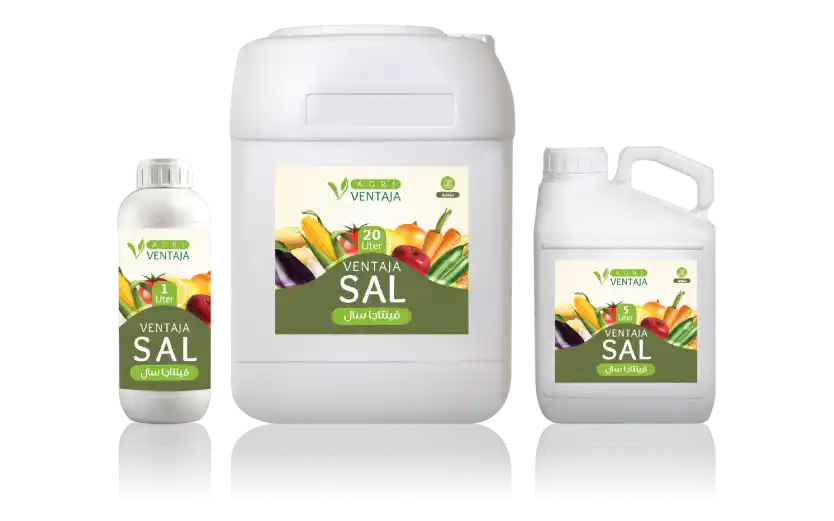
Ventaja® Sal
1 L / 5 L / 20 LVentaja® Sal supplies 10% calcium and 6% nitrogen with a 20% organic fraction. It addresses a physical problem rather than a nutritional one: sodium accumulated on the soil exchange complex disperses clay aggregates, which collapses soil structure and prevents the water movement required to leach the salt away. Calcium displaces sodium from those exchange sites, and the organic fraction rebuilds the aggregate structure.
Analysis
| Total Nitrogen (N) | 6% |
|---|---|
| Calcium Oxide (CaO) | 10% |
| Organic Matter | 20% |
Properties
- pH: 3.0–4.0
- Density: 1.26 g/cm³
- EC mS: 0.55
- Sol (g/L): 100%
- Rates are guidelines; adjust to soil salinity and local practice. Jar test before mixing.
Packing
1 L / 5 L / 20 L
Crops and Application Rates
| Crop | Application rate | Timing / growth stage |
|---|---|---|
| Vegetables | 15–25 L/ha | In saline conditions, during growth |
| Fruit trees | 20–30 L/ha | Throughout the growing cycle |
| Field crops | 15–25 L/ha | At establishment and growth |
Benefits
Agronomic Benefits
- Reduced exchangeable sodium in the root zone
- Restored soil aggregate structure, infiltration and permeability
- Improved water movement, allowing accumulated salts to be leached
- Improved root development in soil that was previously physically restrictive
- Calcium supplied for fruit firmness and structural quality alongside the soil correction
Commercial Advantages
- Addresses the physical cause, not the symptom — salt cannot be leached until structure is restored
- Complete solubility with no residue — protects drippers, filters and spray equipment
- Chelated micronutrients included — no separate corrective inputs required
- Complete dispersion in water at the point of use, with viscosity controlled for accurate dosing
- Compatible with standard fertigation and foliar programmes
Composition and Nutrient System
Composition and Nutrient System
- 10% calcium supplied as the exchangeable cation that displaces sodium from the soil exchange complex
- 20% organic fraction, declared and quantified, contributing exchange capacity and aggregate stability
- An acidic reaction assisting the dissolution of carbonate that immobilises calcium in affected soils
- A nitrogen fraction supporting the crop while the physical correction of the soil proceeds
Technology and mode of action
PhytoCarrier Transport Technology
- Nutrient transport system combining natural carrier molecules with an integrated organic fraction
- Enhances penetration through the leaf cuticle and across root membranes, raising uptake efficiency by both foliar and root routes
- Binds and escorts nutrients to the point of metabolism, so a higher proportion of the applied rate is actually absorbed
- Provides osmotic protection under heat and salinity stress, and conditions the root zone to stimulate microbial activity and lateral root development
Mode of Action
- Sodium held on the exchange complex causes clay particles to disperse rather than flocculate, and the aggregate structure of the soil collapses
- Once structure collapses, infiltration and permeability fall sharply — which prevents the water movement that would otherwise leach the sodium out
- The problem is therefore self-sustaining: the salt cannot be removed because the salt has destroyed the pathway through which it would leave
How Calcium Reverses the Sequence
- Calcium displaces sodium from the exchange sites, and the displaced sodium becomes available to be leached with irrigation water
- With calcium on the exchange complex, clay particles flocculate again and the aggregate structure re-forms
- Restored structure raises infiltration and permeability, which is what allows the displaced sodium to actually move out of the root zone
- The organic fraction accelerates this by binding particles into stable aggregates and adding exchange capacity of its own
Chelation and Micronutrient Protection
- Micronutrients are held in chelated and complexed form, protecting them against precipitation before they reach the plant
- In alkaline irrigation water and in the presence of phosphate, non-chelated iron, zinc, manganese and copper precipitate within minutes and are lost from availability
- An integrated stabilizing fraction protects the chelated metals against oxidative degradation, maintaining them in the form the plant absorbs
Solubility in Use and Physical Consistency
- The operative specification is complete dispersion in water at the point of use — solubility in the tank, not appearance in the container
- Partial settling can occur in any concentrated suspension during storage. The product is shaken before use, which restores full homogeneity and does not affect the delivered analysis
- A controlled rheology system governs viscosity, allowing accurate dosing and clean transfer through injection equipment
- A stabilizing component protects the formulation against microbial degradation throughout storage
Application, compatibility and storage
Application and Compatibility
- Shake well before use
- Fertigation via drip and micro-irrigation; compatible with all injection equipment, hydroponic, NFT and substrate systems
- Foliar application at the recommended dilution
- Suitable for all agricultural soil types
- Mixable with most fertilizers and pesticides; a small-scale compatibility test is recommended before tank-mixing
- Storage: 7–30°C, away from direct sunlight; keep containers sealed
Ventaja®Phospho EdgeSpecialty fertilizers
Purified Phosphoric Acid for Fertigation Programmes
Illustrative packaging
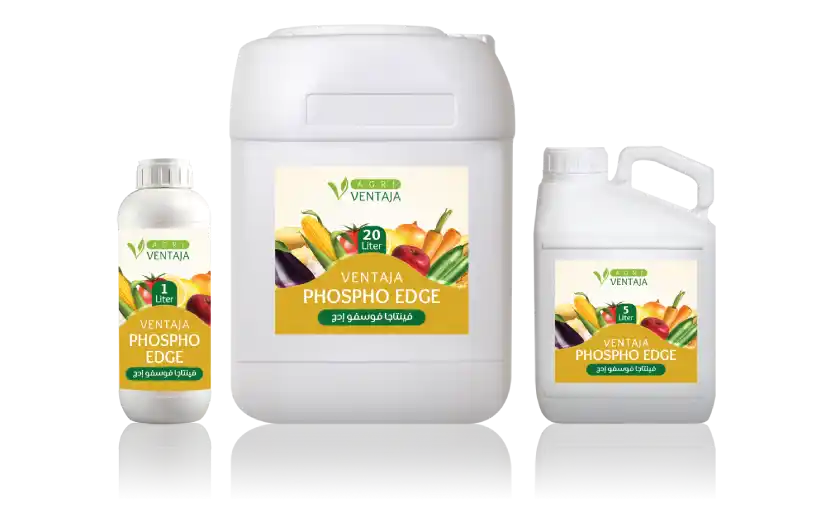 Illustrative packaging
Ventaja® Phospho Edge
5 kg / 25 kg / 30 kg / 1450 kg (IBC)Ventaja® Phospho Edge is a high-phosphorus liquid based on 85% purified phosphoric acid. It performs two functions in a single application: it supplies immediately available phosphorus for root development and flower initiation, and its acidic reaction maintains the irrigation system by dissolving calcium scale and suppressing biological build-up.
Illustrative packagingAnalysis
| Phosphoric Acid (H₃PO₄) | 85% |
|---|
Properties
- pH: 2.0
- Density: 1.40 g/cm³
- EC mS: 3.0 (1/100)
- Sol (g/L): 1000
- Rates are guidelines; handle acid with care. Jar test before mixing.
Packing
5 kg / 25 kg / 30 kg / 1450 kg (IBC)
Crops and Application Rates
| Crop | Application rate | Timing / growth stage |
|---|---|---|
| Vegetables | 3–6 L/ha | Early growth and flowering |
| Fruit trees | 5–10 L/ha | Rooting and flowering stages |
| Field crops | 3–6 L/ha | At establishment |
Benefits
Agronomic Benefits
- Increased root length, branching and absorbing surface area
- More uniform and abundant flower initiation
- Recovery of phosphorus previously fixed and unavailable in the soil
- Improved distribution uniformity through reduced emitter blockage
- Reduced accumulation of scale requiring separate acid-flush operations
Commercial Advantages
- Nutrition and system maintenance in the same application — the acid flush is performed by the fertilisation operation
- Complete solubility with no residue — protects drippers, filters and spray equipment
- Chelated micronutrients included — no separate corrective inputs required
- Complete dispersion in water at the point of use, with viscosity controlled for accurate dosing
- Compatible with standard fertigation and foliar programmes
Composition and Nutrient System
Composition and Nutrient System
- 85% phosphoric acid, manufactured from a purified source and supplied as directly absorbable orthophosphate
- Gypsum-free: no insoluble calcium sulphate fraction is carried into the tank or the irrigation lines
- Presented in packaging sized for standard fertigation programmes and routine operational use
- Strongly acidic reaction performing both nutrition and irrigation-system maintenance in the same application
Technology and mode of action
PhytoCarrier Transport Technology
- Nutrient transport system combining natural carrier molecules built into the formulation
- Enhances penetration through the leaf cuticle and across root membranes, raising uptake efficiency by both foliar and root routes
- Binds and escorts nutrients to the point of metabolism, so a higher proportion of the applied rate is actually absorbed
- Provides osmotic protection under heat and salinity stress
Mode of Action
- Phosphorus is the least mobile major nutrient: a substantial proportion of any application is chemically fixed within days, by calcium in alkaline soils and by iron and aluminium in acid soils
- The acidic reaction lowers pH in the immediate root zone, which raises phosphate solubility and extends the window during which the applied phosphorus remains available
- It additionally releases phosphorus fixed from previous seasons, converting an unavailable soil reserve into available supply
Effect Within the Irrigation System
- The acidic reaction dissolves calcium and lime scale deposited in drippers, filters and lateral lines during application
- It suppresses the biological build-up that restricts flow in warm-season irrigation
- Reduced blockage improves distribution uniformity across the block, which affects every product delivered through the same system
- System maintenance is therefore performed by the fertilisation operation rather than as a separate task
Purity of the Phosphorus Source
- The phosphorus fraction is manufactured from purified phosphoric acid rather than crude acid
- Crude acid carries calcium sulphate (gypsum), which precipitates in the tank and in irrigation lines and forms the sediment that blocks drippers, filters and spray nozzles
- The purified source is gypsum-free: it dissolves completely, produces a clear solution and leaves no residue in the system
- The absence of insoluble sulphate results in a clear solution and eliminates the sediment load carried into the irrigation system
Solubility in Use and Physical Consistency
- The operative specification is complete dispersion in water at the point of use — solubility in the tank, not appearance in the container
- Partial settling can occur in any concentrated suspension during storage. The product is shaken before use, which restores full homogeneity and does not affect the delivered analysis
- A controlled rheology system governs viscosity, allowing accurate dosing and clean transfer through injection equipment
- A stabilizing component protects the formulation against microbial degradation throughout storage
Application, compatibility and storage
Application and Compatibility
- Shake well before use
- Fertigation via drip and micro-irrigation; compatible with all injection equipment, hydroponic, NFT and substrate systems
- Foliar application at the recommended dilution
- Suitable for all agricultural soil types
- Mixable with most fertilizers and pesticides; a small-scale compatibility test is recommended before tank-mixing
- Storage: 7–30°C, away from direct sunlight; keep containers sealed
Ventaja®Phosphoric Acid 85%Specialty fertilizers
Purified Phosphoric Acid — Bulk Presentation
Illustrative packaging
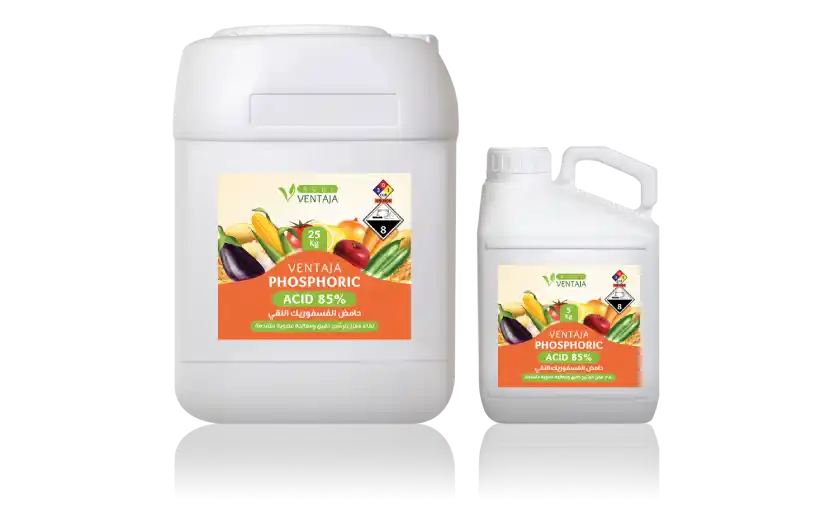 Illustrative packaging
Ventaja® Phosphoric Acid 85%
25 kg / 30 kg / 1450 kg (IBC)Ventaja® Phosphoric Acid 85% is a purified phosphoric acid supplied in bulk and IBC presentation for large-scale operations. It provides the same dual function as the standard grade — immediately available phosphorus together with acidic maintenance of the irrigation system — at a scale and cost structure suited to extensive production areas.
Illustrative packagingAnalysis
| Phosphoric Acid (H₃PO₄) | 85% |
|---|
Properties
- pH: 1.7
- Density: 1.42 g/cm³
- EC mS: 2.5
- Sol (g/L): 100%
- Rates are guidelines; handle acid with care. Jar test before mixing.
Packing
25 kg / 30 kg / 1450 kg (IBC)
Crops and Application Rates
| Crop | Application rate | Timing / growth stage |
|---|---|---|
| Vegetables | 3–6 L/ha | Early growth and flowering |
| Fruit trees | 5–10 L/ha | Rooting and flowering stages |
| Field crops | 3–6 L/ha | At establishment |
Benefits
Agronomic Benefits
- Increased root length, branching and absorbing surface area
- More uniform and abundant flower initiation
- Recovery of phosphorus previously fixed and unavailable in the soil
- Improved distribution uniformity through reduced emitter blockage
- Reduced accumulation of scale requiring separate acid-flush operations
Commercial Advantages
- Bulk presentation — the same purified source at a scale suited to extensive production
- Complete solubility with no residue — protects drippers, filters and spray equipment
- Chelated micronutrients included — no separate corrective inputs required
- Complete dispersion in water at the point of use, with viscosity controlled for accurate dosing
- Compatible with standard fertigation and foliar programmes
Composition and Nutrient System
Composition and Nutrient System
- 85% phosphoric acid, manufactured from a purified source and supplied as directly absorbable orthophosphate
- Gypsum-free: no insoluble calcium sulphate fraction is carried into the tank or the irrigation lines
- Supplied in bulk and IBC presentation, sized for extensive production areas and central injection systems
- Strongly acidic reaction performing both nutrition and irrigation-system maintenance in the same application
Technology and mode of action
PhytoCarrier Transport Technology
- Nutrient transport system combining natural carrier molecules built into the formulation
- Enhances penetration through the leaf cuticle and across root membranes, raising uptake efficiency by both foliar and root routes
- Binds and escorts nutrients to the point of metabolism, so a higher proportion of the applied rate is actually absorbed
- Provides osmotic protection under heat and salinity stress
Mode of Action
- Phosphorus is the least mobile major nutrient: a substantial proportion of any application is chemically fixed within days, by calcium in alkaline soils and by iron and aluminium in acid soils
- The acidic reaction lowers pH in the immediate root zone, which raises phosphate solubility and extends the window during which the applied phosphorus remains available
- It additionally releases phosphorus fixed from previous seasons, converting an unavailable soil reserve into available supply
Effect Within the Irrigation System
- The acidic reaction dissolves calcium and lime scale deposited in drippers, filters and lateral lines during application
- It suppresses the biological build-up that restricts flow in warm-season irrigation
- Reduced blockage improves distribution uniformity across the block, which affects every product delivered through the same system
- System maintenance is therefore performed by the fertilisation operation rather than as a separate task
Purity of the Phosphorus Source
- The phosphorus fraction is manufactured from purified phosphoric acid rather than crude acid
- Crude acid carries calcium sulphate (gypsum), which precipitates in the tank and in irrigation lines and forms the sediment that blocks drippers, filters and spray nozzles
- The purified source is gypsum-free: it dissolves completely, produces a clear solution and leaves no residue in the system
- The absence of insoluble sulphate results in a clear solution and eliminates the sediment load carried into the irrigation system
Solubility in Use and Physical Consistency
- The operative specification is complete dispersion in water at the point of use — solubility in the tank, not appearance in the container
- Partial settling can occur in any concentrated suspension during storage. The product is shaken before use, which restores full homogeneity and does not affect the delivered analysis
- A controlled rheology system governs viscosity, allowing accurate dosing and clean transfer through injection equipment
- A stabilizing component protects the formulation against microbial degradation throughout storage
Application, compatibility and storage
Application and Compatibility
- Shake well before use
- Fertigation via drip and micro-irrigation; compatible with all injection equipment, hydroponic, NFT and substrate systems
- Foliar application at the recommended dilution
- Suitable for all agricultural soil types
- Mixable with most fertilizers and pesticides; a small-scale compatibility test is recommended before tank-mixing
- Storage: 7–30°C, away from direct sunlight; keep containers sealed
Ventaja®Cal-MagSpecialty fertilizers
Liquid Calcium–Magnesium with PhytoCarrier Technology
Ventaja® Cal-Mag
1 L / 5 L / 20 LVentaja® Cal-Mag is a liquid calcium and magnesium formulation addressing the three constraints that limit these two elements in practice: restricted mobility within the plant, low utilisation efficiency, and ionic antagonism with competing cations. Both elements are supplied in an active liquid form and carried by PhytoCarrier transport technology, which raises the proportion of the applied rate that is actually absorbed and translocated.
Analysis
| Total Nitrogen (N) | 15% |
|---|---|
| Calcium (CaO) | 19% |
| Magnesium (MgO) | 2.5% |
Properties
- pH: 4.0–6.0
- Density: 1.46 g/cm³
- EC mS: 1.0
- Sol (g/L): 100%
- Rates are guidelines; adjust to crop stage, deficiency severity and local practice.
Packing
1 L / 5 L / 20 L
Crops and Application Rates
| Crop | Soil / fertigation rate | Foliar rate | Timing / growth stage |
|---|---|---|---|
| Pome fruits | 15–25 L/ha | 2–3 L/ha | 7–10 applications during fruiting; last one 2 weeks before harvest |
| Vegetables | 15–25 L/ha | 1.5–2 L/ha | 2–3 times per season during fruiting stage |
| Lettuce | 10–15 L/ha | 1–2 L/ha | 2–3 times per season |
| Grapes | 15–20 L/ha | 2–2.5 L/ha | 3–4 applications after fruit setting |
| Tomato | 15–25 L/ha | 1.5–2 L/ha | Every 2 weeks during fruit development |
| Cereals | — | 4–6 L/ha | Twice per season |
| Sugar beet | — | 5–6 L/ha | 3–4 times per season |
Benefits
Agronomic Benefits
- Stronger, more uniform cell walls with reduced cracking and physiological disorders
- Improved photosynthetic activity through chlorophyll synthesis and magnesium stability in the chloroplast
- Improved nitrogen use efficiency, directed toward structural rather than soft vegetative growth
- Improved intracellular cation balance and sap flow dynamics
- Improved fruit firmness, colour and post-harvest shelf life
Commercial Advantages
- Calcium and magnesium in one product — prevents the induced magnesium deficiency that follows a calcium-only programme
- Complete solubility with no residue — protects drippers, filters and spray equipment
- Chelated micronutrients included — no separate corrective inputs required
- Complete dispersion in water at the point of use, with viscosity controlled for accurate dosing
- Compatible with standard fertigation and foliar programmes
Composition and Nutrient System
Composition and Nutrient System
- Calcium and magnesium supplied together in an active liquid form, immediately available without a dissolution step
- A nitrogen fraction supporting uptake and structural growth rather than excessive vegetative extension
- Selected trace elements acting as enzymatic cofactors, preventing the secondary deficiencies that accompany calcium correction
- An internal stabilization system maintaining nutrient efficiency under saline stress and fluctuating pH
Technology and mode of action
PhytoCarrier Transport Technology
- Nutrient transport system combining natural carrier molecules with an integrated organic fraction
- Enhances penetration through the leaf cuticle and across root membranes, raising uptake efficiency by both foliar and root routes
- Binds and escorts nutrients to the point of metabolism, so a higher proportion of the applied rate is actually absorbed
- Provides osmotic protection under heat and salinity stress, and conditions the root zone to stimulate microbial activity and lateral root development
Mode of Action
- Calcium cross-links pectin in the middle lamella of the cell wall, the structural bond determining tissue firmness and resistance to breakdown
- Calcium moves only in the xylem, carried by the transpiration stream, and is phloem-immobile: it cannot be redistributed from older tissue once deposited
- It therefore reaches leaves readily but reaches fruit and low-transpiration tissue poorly, which is why continuous supply is required rather than a single correction
Magnesium Function and the Cation Balance
- Magnesium is the central atom of every chlorophyll molecule and therefore sets the ceiling on light capture and carbohydrate production
- Calcium, magnesium and potassium compete for the same root uptake sites; an imbalance in any one suppresses the others
- Supplying calcium and magnesium together in a fixed ratio prevents the induced magnesium deficiency that follows a calcium-only correction
Chelation and Micronutrient Protection
- Micronutrients are held in chelated and complexed form, protecting them against precipitation before they reach the plant
- In alkaline irrigation water and in the presence of phosphate, non-chelated iron, zinc, manganese and copper precipitate within minutes and are lost from availability
- An integrated stabilizing fraction protects the chelated metals against oxidative degradation, maintaining them in the form the plant absorbs
Solubility in Use and Physical Consistency
- The operative specification is complete dispersion in water at the point of use — solubility in the tank, not appearance in the container
- Partial settling can occur in any concentrated suspension during storage. The product is shaken before use, which restores full homogeneity and does not affect the delivered analysis
- A stabilizing component protects the formulation against microbial degradation during storage
- A controlled rheology system governs viscosity, allowing accurate dosing and clean transfer through injection equipment
Application, compatibility and storage
Application and Compatibility
- Shake well before use
- Fertigation via drip and micro-irrigation; compatible with all injection equipment, hydroponic, NFT and substrate systems
- Foliar application at the recommended dilution
- Suitable for all agricultural soil types
- Mixable with most fertilizers and pesticides; a small-scale compatibility test is recommended before tank-mixing
- Storage: 7–30°C, away from direct sunlight; keep containers sealed
Ventaja®FosterSpecialty fertilizers
Boron–Zinc Liquid with Organic Nitrogen for the Reproductive Phase
Ventaja® Foster
1 L / 5 L / 20 LVentaja® Foster supplies 4% boron and 4% zinc with 8.5% organic nitrogen and 13.5% amino acids. The combination targets the reproductive phase specifically: boron governs pollen tube growth and fertilisation, zinc governs the synthesis of the growth hormone that regulates fruit development, and the amino fraction supplies the precursors and carrier capacity both processes require.
Analysis
| Organic Nitrogen | 8.5% |
|---|---|
| Boron (B) | 4% |
| Zinc (Zn) | 4% |
| Amino Acids | 13.5% |
Properties
- pH: 8.0–9.0
- Density: 1.25 g/cm³
- EC mS: 0.3
- Sol (g/L): 100%
- Rates are guidelines; adjust to crop stage and local practice. Jar test before mixing.
Packing
1 L / 5 L / 20 L
Crops and Application Rates
| Crop | Soil / fertigation rate | Foliar rate | Timing / growth stage |
|---|---|---|---|
| Vegetables | 3–5 L/ha | 1.5–2 L/ha | Before and during flowering |
| Fruit trees | 5–7 L/ha | 2–3 L/ha | Pre-flowering to fruit set |
| Grapes & strawberries | 4–6 L/ha | 1.5–2.5 L/ha | Flowering and early fruit set |
| Field crops | 3–5 L/ha | 1.5–2 L/ha | Reproductive stages |
Benefits
Agronomic Benefits
- Higher pollen viability and fertilisation rate during the flowering window
- Improved flower retention and fruit-set percentage
- More uniform fruit set across the flowering period
- Improved carbohydrate and calcium transport into developing tissue
Commercial Advantages
- Boron, zinc and the organic fraction in one product — the three inputs the reproductive phase depends on
- Complete solubility with no residue — protects drippers, filters and spray equipment
- Chelated micronutrients included — no separate corrective inputs required
- Complete dispersion in water at the point of use, with viscosity controlled for accurate dosing
- Compatible with standard fertigation and foliar programmes
Composition and Nutrient System
Composition and Nutrient System
- 4% boron and 4% zinc in bioavailable form, matched to reproductive-stage demand
- 8.5% organic nitrogen and 13.5% amino acids, declared and quantified as part of the analysis
- The amino fraction supplies precursors for reproductive signalling compounds and acts as a natural chelating agent
- Mild acidification improves boron and zinc availability in alkaline conditions, where both are readily immobilised
Technology and mode of action
PhytoCarrier Transport Technology
- Nutrient transport system combining natural carrier molecules with an integrated organic fraction
- Enhances penetration through the leaf cuticle and across root membranes, raising uptake efficiency by both foliar and root routes
- Binds and escorts nutrients to the point of metabolism, so a higher proportion of the applied rate is actually absorbed
- Provides osmotic protection under heat and salinity stress, and conditions the root zone to stimulate microbial activity and lateral root development
Mode of Action
- Boron is required for pollen tube elongation and fertilisation; where boron is limiting, flowering proceeds normally but fertilisation fails and fruit set is poor
- Boron also forms the reversible complexes with sugars that transport carbohydrate through the phloem, and it carries calcium into developing tissue
- Boron is immobile in most species, so it cannot be remobilised from older tissue and supply must be continuous through the reproductive window
Zinc Function and the Organic Fraction
- Zinc is required for synthesis of the principal plant growth hormone, which regulates cell division and expansion in developing fruit
- Zinc deficiency restricts fruit development before any visible discoloration appears, so the loss precedes the symptom
- The organic nitrogen and amino fractions supply the nitrogen skeleton and carrier capacity that both boron and zinc functions depend on
Chelation and Micronutrient Protection
- Micronutrients are held in chelated and complexed form, protecting them against precipitation before they reach the plant
- In alkaline irrigation water and in the presence of phosphate, non-chelated iron, zinc, manganese and copper precipitate within minutes and are lost from availability
- An integrated stabilizing fraction protects the chelated metals against oxidative degradation, maintaining them in the form the plant absorbs
Solubility in Use and Physical Consistency
- The operative specification is complete dispersion in water at the point of use — solubility in the tank, not appearance in the container
- Partial settling can occur in any concentrated suspension during storage. The product is shaken before use, which restores full homogeneity and does not affect the delivered analysis
- A stabilizing component protects the formulation against microbial degradation during storage
- A controlled rheology system governs viscosity, allowing accurate dosing and clean transfer through injection equipment
Application, compatibility and storage
Application and Compatibility
- Shake well before use
- Fertigation via drip and micro-irrigation; compatible with all injection equipment, hydroponic, NFT and substrate systems
- Foliar application at the recommended dilution
- Suitable for all agricultural soil types
- Mixable with most fertilizers and pesticides; a small-scale compatibility test is recommended before tank-mixing
- Storage: 7–30°C, away from direct sunlight; keep containers sealed
Ventaja®ZinMan ASpecialty fertilizers
Liquid Manganese–Zinc for Combined Deficiency Correction
Product image unavailable
Ventaja® ZinMan A
1 L / 5 L / 20 LVentaja® ZinMan A supplies 6% manganese and 6% zinc in equal proportion. The two elements are combined because they share a single limiting cause: both are immobilised by the same soil chemistry — high pH, high carbonate content and high organic matter — and both operate in photosynthetic and enzymatic function. Correcting one in isolation frequently exposes the limitation of the other.
Analysis
| Manganese (Mn) | 6% |
|---|---|
| Zinc (Zn) | 6% |
Properties
- pH: 8.5
- Density: 1.35 g/cm³
- EC mS: 0.45
- Sol (g/L): 100%
- Rates are guidelines; adjust to crop stage and local practice. Jar test before mixing.
Packing
1 L / 5 L / 20 L
Crops and Application Rates
| Crop | Soil / fertigation rate | Foliar rate | Timing / growth stage |
|---|---|---|---|
| Vegetables | 2–4 L/ha | 1–2 L/ha | Active growth and pre-flowering |
| Fruit trees | 4–6 L/ha | 1.5–2.5 L/ha | Vegetative and fruit-development stages |
| Field crops | 3–5 L/ha | 1–2 L/ha | Early growth and correction |
| Citrus | 4–6 L/ha | — | At deficiency symptoms |
Benefits
Agronomic Benefits
- Correction of combined manganese and zinc deficiency in a single application
- Restored photosynthetic efficiency and chlorophyll content
- Normalised internode extension and leaf expansion
- Improved tolerance to heat, drought and high-light stress
Commercial Advantages
- One shared limiting cause, one product — correcting either element alone can expose the other
- Complete solubility with no residue — protects drippers, filters and spray equipment
- Chelated micronutrients included — no separate corrective inputs required
- Complete dispersion in water at the point of use, with viscosity controlled for accurate dosing
- Compatible with standard fertigation and foliar programmes
Composition and Nutrient System
Composition and Nutrient System
- 6% manganese and 6% zinc in equal proportion, addressing the pair as a single limitation
- Dual chelation architecture protecting both metals against competition from calcium and bicarbonate
- An amino carrier fraction supporting resynthesis of the enzyme systems affected by the deficiency
- Mild root-zone acidification improving availability in hard irrigation water and alkaline soils
Technology and mode of action
PhytoCarrier Transport Technology
- Nutrient transport system combining natural carrier molecules with an integrated organic fraction
- Enhances penetration through the leaf cuticle and across root membranes, raising uptake efficiency by both foliar and root routes
- Binds and escorts nutrients to the point of metabolism, so a higher proportion of the applied rate is actually absorbed
- Provides osmotic protection under heat and salinity stress, and conditions the root zone to stimulate microbial activity and lateral root development
Mode of Action
- Zinc is required for synthesis of the principal plant growth hormone and for RNA polymerase function; deficiency restricts internode extension and leaf expansion
- Manganese is the essential cofactor of the water-splitting complex in Photosystem II, the reaction that releases the electrons photosynthesis depends on
- Both contribute to the antioxidant enzyme systems that limit oxidative damage under heat, drought and high light
Why the Two Are Supplied Together
- Both are immobilised by the same soil conditions: elevated pH, carbonate content and organic matter
- Because a single cause limits both, correcting one element alone raises demand on the other and can expose a second deficiency
- Supplying them in equal proportion addresses the shared limitation rather than one half of it
Chelation and Micronutrient Protection
- Micronutrients are held in chelated and complexed form, protecting them against precipitation before they reach the plant
- In alkaline irrigation water and in the presence of phosphate, non-chelated iron, zinc, manganese and copper precipitate within minutes and are lost from availability
- An integrated stabilizing fraction protects the chelated metals against oxidative degradation, maintaining them in the form the plant absorbs
Solubility in Use and Physical Consistency
- The operative specification is complete dispersion in water at the point of use — solubility in the tank, not appearance in the container
- Partial settling can occur in any concentrated suspension during storage. The product is shaken before use, which restores full homogeneity and does not affect the delivered analysis
- A stabilizing component protects the formulation against microbial degradation during storage
- A controlled rheology system governs viscosity, allowing accurate dosing and clean transfer through injection equipment
Application, compatibility and storage
Application and Compatibility
- Shake well before use
- Fertigation via drip and micro-irrigation; compatible with all injection equipment, hydroponic, NFT and substrate systems
- Foliar application at the recommended dilution
- Suitable for all agricultural soil types
- Mixable with most fertilizers and pesticides; a small-scale compatibility test is recommended before tank-mixing
- Storage: 7–30°C, away from direct sunlight; keep containers sealed
Ventaja®MagniGro 10%Specialty fertilizers
Liquid Magnesium with Amino Carrier

Ventaja® MagniGro 10%
1 L / 5 L / 20 LVentaja® MagniGro 10% supplies 10% magnesium with a 3% amino fraction. Magnesium is the central atom of every chlorophyll molecule, which makes it the direct determinant of light-harvesting capacity. It is also an activator of a large number of enzymes and is required for the phloem loading of sucrose — so it governs both the production of carbohydrate and its movement.
Analysis
| Magnesium (MgO) | 10% |
|---|---|
| Amino Acids | 3% |
Properties
- pH: 9.5
- Density: 1.20 g/cm³
- EC mS: 1.2
- Sol (g/L): 1000
- Rates are guidelines; adjust to crop stage and local practice. Jar test before mixing.
Packing
1 L / 5 L / 20 L
Crops and Application Rates
| Crop | Soil / fertigation rate | Timing / growth stage |
|---|---|---|
| Vegetables | 2–3 kg/500 m² (soil) | Early flowering to fruit development |
| Fruit trees | 10–12 kg/ha (soil) | Flowering and fruit development |
| Ornamentals | 10 kg/ha (soil) | As needed |
| Nurseries | 100–150 ml/100 L (foliar) | Hardening stage |
Benefits
Agronomic Benefits
- Restored chlorophyll content and photosynthetic capacity
- Correction of interveinal chlorosis on older leaves
- Improved carbohydrate transport from leaf tissue toward developing fruit
- Improved tolerance of the cation competition that accompanies heavy potassium programmes
Commercial Advantages
- Addresses the deficiency that heavy potassium programmes induce — the two are applied in the same period
- Complete solubility with no residue — protects drippers, filters and spray equipment
- Chelated micronutrients included — no separate corrective inputs required
- Complete dispersion in water at the point of use, with viscosity controlled for accurate dosing
- Compatible with standard fertigation and foliar programmes
Composition and Nutrient System
Composition and Nutrient System
- 10% magnesium in readily available liquid form, requiring no dissolution step
- A 3% amino fraction acting as a natural chelating agent and improving uptake and internal translocation
- An acidic reaction improving the solubility of magnesium and co-applied elements in the root zone
- Suitable for both soil and foliar routes, since magnesium is absorbed efficiently through the leaf
Technology and mode of action
PhytoCarrier Transport Technology
- Nutrient transport system combining natural carrier molecules with an integrated organic fraction
- Enhances penetration through the leaf cuticle and across root membranes, raising uptake efficiency by both foliar and root routes
- Binds and escorts nutrients to the point of metabolism, so a higher proportion of the applied rate is actually absorbed
- Provides osmotic protection under heat and salinity stress, and conditions the root zone to stimulate microbial activity and lateral root development
Mode of Action
- Magnesium occupies the centre of the chlorophyll molecule; chlorophyll content and therefore light capture are directly limited by its supply
- It activates the enzymes of energy transfer and carbohydrate metabolism, including those governing phosphate transfer reactions
- It is required for phloem loading of sucrose, so magnesium deficiency restricts the movement of carbohydrate from leaf to fruit even where photosynthesis continues
Deficiency Pattern and Cation Competition
- Magnesium is phloem-mobile: it is remobilised from older leaves to supply new growth, so interveinal chlorosis appears first on older leaves while young growth stays green
- Potassium, calcium and ammonium compete with magnesium for the same root uptake sites; a heavy potassium programme can induce magnesium deficiency in soil that tests adequate
- This is why magnesium requirement rises specifically during heavy fruit fill, when potassium application is at its highest
Chelation and Micronutrient Protection
- Micronutrients are held in chelated and complexed form, protecting them against precipitation before they reach the plant
- In alkaline irrigation water and in the presence of phosphate, non-chelated iron, zinc, manganese and copper precipitate within minutes and are lost from availability
- An integrated stabilizing fraction protects the chelated metals against oxidative degradation, maintaining them in the form the plant absorbs
Solubility in Use and Physical Consistency
- The operative specification is complete dispersion in water at the point of use — solubility in the tank, not appearance in the container
- Partial settling can occur in any concentrated suspension during storage. The product is shaken before use, which restores full homogeneity and does not affect the delivered analysis
- A controlled rheology system governs viscosity, allowing accurate dosing and clean transfer through injection equipment
- A stabilizing component protects the formulation against microbial degradation throughout storage
Application, compatibility and storage
Application and Compatibility
- Shake well before use
- Fertigation via drip and micro-irrigation; compatible with all injection equipment, hydroponic, NFT and substrate systems
- Foliar application at the recommended dilution
- Suitable for all agricultural soil types
- Mixable with most fertilizers and pesticides; a small-scale compatibility test is recommended before tank-mixing
- Storage: 7–30°C, away from direct sunlight; keep containers sealed
Ventaja®CalciBorSpecialty fertilizers
Liquid Calcium–Boron with Acidic Reaction
Ventaja® CalciBor
1 L / 5 L / 20 LVentaja® CalciBor supplies 10% calcium and 0.5% boron in an acidic liquid. The two elements are combined because boron is required for the movement of calcium into developing tissue: where boron is limiting, applied calcium is absorbed but poorly delivered to the tissue that needs it. The low pH of the formulation raises the availability of both elements, particularly in alkaline soils and hard irrigation water.
Analysis
| Boron (B) | 0.5% |
|---|---|
| Calcium (CaO) | 10% |
Properties
- pH: 2.5
- Density: 1.32 g/cm³
- EC mS: 0.45
- Sol (g/L): 100%
- Rates are guidelines; adjust to crop stage and local practice. Jar test before mixing.
Packing
1 L / 5 L / 20 L
Crops and Application Rates
| Crop | Foliar rate | Soil / fertigation rate | Timing / growth stage |
|---|---|---|---|
| Vegetables | 200–300 ml/100 L | 2–3 L/500 m² | Flowering, fruit set and growth |
| Greenhouses | — | 4–5 L/1000 m² | Fruit set to full development |
| Fruit trees | 300–400 ml/100 L | 5–6 L/ha | Flowering through fruit growth |
| Ornamentals | 150–200 ml/100 L | — | At deficiency symptoms |
Benefits
Agronomic Benefits
- Increased tissue firmness and reduced incidence of physiological breakdown disorders
- Improved pollination and fruit set through the boron fraction
- Improved surface uniformity and reduced cracking
- Extended post-harvest shelf life
Commercial Advantages
- Calcium delivered with the element that transports it — correcting calcium alone gives an incomplete response
- Complete solubility with no residue — protects drippers, filters and spray equipment
- Chelated micronutrients included — no separate corrective inputs required
- Complete dispersion in water at the point of use, with viscosity controlled for accurate dosing
- Compatible with standard fertigation and foliar programmes
Composition and Nutrient System
Composition and Nutrient System
- 10% calcium and 0.5% boron supplied together, at the proportion required for calcium transport
- An acidic reaction raising the availability of both elements in alkaline soils and hard irrigation water
- Suitable for both foliar application and drip delivery, allowing correction by whichever route is faster
- A carrier fraction improving uptake of calcium, which is otherwise poorly mobile within the plant
Technology and mode of action
PhytoCarrier Transport Technology
- Nutrient transport system combining natural carrier molecules built into the formulation
- Enhances penetration through the leaf cuticle and across root membranes, raising uptake efficiency by both foliar and root routes
- Binds and escorts nutrients to the point of metabolism, so a higher proportion of the applied rate is actually absorbed
- Provides osmotic protection under heat and salinity stress
Mode of Action
- Calcium cross-links pectin in the middle lamella of the cell wall, the structural bond determining tissue firmness
- Calcium moves only in the xylem with the transpiration stream and is phloem-immobile, so it reaches leaves readily but reaches fruit poorly
- Because it cannot be redistributed once deposited, correction depends on timing and frequency during tissue expansion rather than on total quantity applied
Why Boron Is Supplied With Calcium
- Boron cross-links a different cell wall polysaccharide from calcium; the two bonds together form the structural network of the wall
- Boron is required for the movement of calcium into developing tissue — correcting calcium alone therefore produces an incomplete response where boron is limiting
- This is why calcium and boron deficiency symptoms frequently present together in the same tissue
Chelation and Micronutrient Protection
- Micronutrients are held in chelated and complexed form, protecting them against precipitation before they reach the plant
- In alkaline irrigation water and in the presence of phosphate, non-chelated iron, zinc, manganese and copper precipitate within minutes and are lost from availability
- An integrated stabilizing fraction protects the chelated metals against oxidative degradation, maintaining them in the form the plant absorbs
Solubility in Use and Physical Consistency
- The operative specification is complete dispersion in water at the point of use — solubility in the tank, not appearance in the container
- Partial settling can occur in any concentrated suspension during storage. The product is shaken before use, which restores full homogeneity and does not affect the delivered analysis
- A controlled rheology system governs viscosity, allowing accurate dosing and clean transfer through injection equipment
- A stabilizing component protects the formulation against microbial degradation throughout storage
Application, compatibility and storage
Application and Compatibility
- Shake well before use
- Fertigation via drip and micro-irrigation; compatible with all injection equipment, hydroponic, NFT and substrate systems
- Foliar application at the recommended dilution
- Suitable for all agricultural soil types
- Mixable with most fertilizers and pesticides; a small-scale compatibility test is recommended before tank-mixing
- Storage: 7–30°C, away from direct sunlight; keep containers sealed
Ventaja®BoroZnSpecialty fertilizers
High-Boron Liquid with Zinc
Ventaja® BoroZn
1 L / 5 L / 20 LVentaja® BoroZn supplies 10% boron with 3% zinc. The boron-dominant ratio is intended for situations where pollination and fruit set are the limiting step, and where boron requirement is high relative to other micronutrients. The zinc fraction supports the growth-hormone synthesis on which fruit development depends after set has occurred.
Analysis
| Boron (B) | 10% |
|---|---|
| Zinc (Zn) | 3% |
Properties
- pH: 8.5
- Density: 1.34 g/cm³
- EC mS: 0.25
- Sol (g/L): 100%
- Rates are guidelines; caution mixing with acidic fertilizers. Jar test before mixing.
Packing
1 L / 5 L / 20 L
Crops and Application Rates
| Crop | Foliar rate | Timing / growth stage |
|---|---|---|
| Vegetables | 150–250 ml/100 L | Before and during flowering |
| Fruit trees | 200–300 ml/100 L | Pre-flowering to fruit set |
| Field crops | 150–250 ml/100 L | At reproductive stages |
Benefits
Agronomic Benefits
- Higher pollen viability and fertilisation rate during the flowering window
- Improved fruit-set percentage and reduced early drop
- Improved carbohydrate transport toward developing fruit
- Prevention of the tissue deformities associated with combined boron and zinc deficiency
Commercial Advantages
- Boron-dominant ratio — for situations where fertilisation, not nutrition, is the limiting step
- Complete solubility with no residue — protects drippers, filters and spray equipment
- Chelated micronutrients included — no separate corrective inputs required
- Complete dispersion in water at the point of use, with viscosity controlled for accurate dosing
- Compatible with standard fertigation and foliar programmes
Composition and Nutrient System
Composition and Nutrient System
- 10% boron — a boron-dominant ratio for situations where pollination and set are the limiting step
- 3% zinc supporting the growth-hormone synthesis that governs fruit development after set
- Formulated for foliar delivery, which is the faster route for both elements during the flowering window
- Alkaline reaction, suited to acid soils; a compatibility test is advised before mixing with strongly acidic products
Technology and mode of action
PhytoCarrier Transport Technology
- Nutrient transport system combining natural carrier molecules built into the formulation
- Enhances penetration through the leaf cuticle and across root membranes, raising uptake efficiency by both foliar and root routes
- Binds and escorts nutrients to the point of metabolism, so a higher proportion of the applied rate is actually absorbed
- Provides osmotic protection under heat and salinity stress
Mode of Action
- Boron cross-links the cell wall polysaccharide network, contributing directly to tissue structural integrity
- It forms reversible complexes with sugar molecules, and these complexes are the mechanism by which sugars are transported through the phloem
- It is required for pollen tube elongation and fertilisation; where boron is limiting, flowering proceeds normally but fertilisation fails
Immobility and the Requirement for Continuous Supply
- Boron is immobile in most species: it cannot be remobilised from older tissue, so an interruption in supply affects new growth immediately while older tissue remains unaffected
- Deficiency therefore appears at growing points, in flowers and in developing fruit — the tissue that determines yield
- Boron is readily leached from light soils and its availability falls as soil pH rises, so application should be preventive and repeated rather than corrective
Chelation and Micronutrient Protection
- Micronutrients are held in chelated and complexed form, protecting them against precipitation before they reach the plant
- In alkaline irrigation water and in the presence of phosphate, non-chelated iron, zinc, manganese and copper precipitate within minutes and are lost from availability
- An integrated stabilizing fraction protects the chelated metals against oxidative degradation, maintaining them in the form the plant absorbs
Solubility in Use and Physical Consistency
- The operative specification is complete dispersion in water at the point of use — solubility in the tank, not appearance in the container
- Partial settling can occur in any concentrated suspension during storage. The product is shaken before use, which restores full homogeneity and does not affect the delivered analysis
- A controlled rheology system governs viscosity, allowing accurate dosing and clean transfer through injection equipment
- A stabilizing component protects the formulation against microbial degradation throughout storage
Application, compatibility and storage
Application and Compatibility
- Shake well before use
- Fertigation via drip and micro-irrigation; compatible with all injection equipment, hydroponic, NFT and substrate systems
- Foliar application at the recommended dilution
- Suitable for all agricultural soil types
- Mixable with most fertilizers and pesticides; a small-scale compatibility test is recommended before tank-mixing
- Storage: 7–30°C, away from direct sunlight; keep containers sealed
Ventaja®BoroZincSpecialty fertilizers
Balanced Boron–Zinc Liquid

Ventaja® BoroZinc
1 L / 5 L / 20 LVentaja® BoroZinc supplies 4% boron and 4% zinc in equal proportion. The balanced ratio is intended for programmes in which both elements are moderately limiting rather than one dominating, and for repeated application across the growth cycle rather than a single corrective dose at flowering.
Analysis
| Boron (B) | 4% |
|---|---|
| Zinc (Zn) | 4% |
Properties
- pH: 8.2
- Density: 1.26 g/cm³
- EC mS: 1.0
- Sol (g/L): 100%
- Rates are guidelines; adjust to crop stage and local practice. Jar test before mixing.
Packing
1 L / 5 L / 20 L
Crops and Application Rates
| Crop | Foliar rate | Timing / growth stage |
|---|---|---|
| Vegetables | 150–250 ml/100 L | Before flowering |
| Fruit trees | 200–300 ml/100 L | Pre-flowering to fruit set |
| Field crops | 150–250 ml/100 L | At reproductive stages |
Benefits
Agronomic Benefits
- Improved pollination and fruit set through the boron fraction
- Normalised internode extension and leaf expansion through restored hormone synthesis
- Improved carbohydrate and calcium transport into developing tissue
- Maintained micronutrient status across the cycle rather than a single corrective peak
Commercial Advantages
- Balanced ratio for repeated application — maintains status rather than correcting after the fact
- Complete solubility with no residue — protects drippers, filters and spray equipment
- Chelated micronutrients included — no separate corrective inputs required
- Complete dispersion in water at the point of use, with viscosity controlled for accurate dosing
- Compatible with standard fertigation and foliar programmes
Composition and Nutrient System
Composition and Nutrient System
- 4% boron and 4% zinc in equal proportion, for programmes where both are moderately limiting
- Concentration selected for repeated application across the growth cycle rather than a single corrective dose
- Both elements supplied in a form that resists precipitation in alkaline irrigation water
- Suitable for both foliar and fertigation routes across the full production cycle
Technology and mode of action
PhytoCarrier Transport Technology
- Nutrient transport system combining natural carrier molecules built into the formulation
- Enhances penetration through the leaf cuticle and across root membranes, raising uptake efficiency by both foliar and root routes
- Binds and escorts nutrients to the point of metabolism, so a higher proportion of the applied rate is actually absorbed
- Provides osmotic protection under heat and salinity stress
Mode of Action
- Boron cross-links the cell wall polysaccharide network, contributing directly to tissue structural integrity
- It forms reversible complexes with sugar molecules, and these complexes are the mechanism by which sugars are transported through the phloem
- It is required for pollen tube elongation and fertilisation; where boron is limiting, flowering proceeds normally but fertilisation fails
Zinc Function and the Case for a Balanced Ratio
- Zinc is required for synthesis of the principal plant growth hormone and for enzyme systems governing carbon dioxide handling and protein synthesis
- Zinc deficiency restricts internode extension and leaf expansion before any visible discoloration appears, so the loss precedes the symptom
- Where neither element is acutely deficient but both are marginal, a balanced ratio applied repeatedly maintains supply more reliably than a single high-dose correction
Chelation and Micronutrient Protection
- Micronutrients are held in chelated and complexed form, protecting them against precipitation before they reach the plant
- In alkaline irrigation water and in the presence of phosphate, non-chelated iron, zinc, manganese and copper precipitate within minutes and are lost from availability
- An integrated stabilizing fraction protects the chelated metals against oxidative degradation, maintaining them in the form the plant absorbs
Solubility in Use and Physical Consistency
- The operative specification is complete dispersion in water at the point of use — solubility in the tank, not appearance in the container
- Partial settling can occur in any concentrated suspension during storage. The product is shaken before use, which restores full homogeneity and does not affect the delivered analysis
- A controlled rheology system governs viscosity, allowing accurate dosing and clean transfer through injection equipment
- A stabilizing component protects the formulation against microbial degradation throughout storage
Application, compatibility and storage
Application and Compatibility
- Shake well before use
- Fertigation via drip and micro-irrigation; compatible with all injection equipment, hydroponic, NFT and substrate systems
- Foliar application at the recommended dilution
- Suitable for all agricultural soil types
- Mixable with most fertilizers and pesticides; a small-scale compatibility test is recommended before tank-mixing
- Storage: 7–30°C, away from direct sunlight; keep containers sealed
Ventaja®Boron 17% (Liquid)Specialty fertilizers
High-Concentration Liquid Boron
Ventaja® Boron 17% (Liquid)
1 L / 5 L / 20 LVentaja® Boron 17% is a single-element liquid supplying 17% boron, the highest boron concentration in the liquid range. Boron governs three distinct processes — structural cross-linking of the cell wall, sugar transport through the phloem, and pollination and fertilisation. Because it is immobile in most species, supply must be continuous through the periods in which those processes occur.
Analysis
| Boric Acid | 17% |
|---|
Properties
- pH: 8.0
- Density: 1.30 g/cm³
- EC mS: 1.0
- Sol (g/L): 100%
- Rates are guidelines; adjust to crop stage and local practice. Jar test before mixing.
Packing
1 L / 5 L / 20 L
Crops and Application Rates
| Crop | Foliar rate | Timing / growth stage |
|---|---|---|
| Vegetables | 100–200 ml/100 L | Before and during flowering |
| Fruit trees | 150–250 ml/100 L | Pre-flowering to fruit set |
| Field crops | 100–200 ml/100 L | At reproductive stages |
Benefits
Agronomic Benefits
- Improved pollination, fertilisation and fruit-set percentage
- Prevention of the internal breakdown and tissue collapse associated with boron deficiency
- Improved sugar transport into fruit and storage tissue
- Improved movement of calcium into developing tissue
Commercial Advantages
- Single-element dosing — boron has a narrow range between deficiency and excess, and this allows the rate to be set precisely
- Complete solubility with no residue — protects drippers, filters and spray equipment
- Chelated micronutrients included — no separate corrective inputs required
- Complete dispersion in water at the point of use, with viscosity controlled for accurate dosing
- Compatible with standard fertigation and foliar programmes
Composition and Nutrient System
Composition and Nutrient System
- 17% boron — the highest boron concentration in the Ventaja liquid range
- Single-element formulation, allowing boron to be dosed independently of any other nutrient programme
- High solubility with no dissolution step, suitable for both foliar and drip delivery
- A complexing fraction maintaining boron in available form as irrigation water alkalinity rises
Technology and mode of action
PhytoCarrier Transport Technology
- Nutrient transport system combining natural carrier molecules built into the formulation
- Enhances penetration through the leaf cuticle and across root membranes, raising uptake efficiency by both foliar and root routes
- Binds and escorts nutrients to the point of metabolism, so a higher proportion of the applied rate is actually absorbed
- Provides osmotic protection under heat and salinity stress
Mode of Action
- Boron cross-links the cell wall polysaccharide network, contributing directly to tissue structural integrity
- It forms reversible complexes with sugar molecules, and these complexes are the mechanism by which sugars are transported through the phloem
- It is required for pollen tube elongation and fertilisation; where boron is limiting, flowering proceeds normally but fertilisation fails
Immobility and Dosing Discipline
- Boron is immobile in most species: it cannot be remobilised from older tissue, so an interruption in supply affects new growth immediately while older tissue remains unaffected
- Deficiency therefore appears at growing points, in flowers and in developing fruit — the tissue that determines yield
- Boron is readily leached from light soils and its availability falls as soil pH rises, so application should be preventive and repeated rather than corrective
- Boron also has a comparatively narrow range between deficiency and excess, so a single-element product allows the rate to be controlled precisely rather than being fixed by a blended analysis
Chelation and Micronutrient Protection
- Micronutrients are held in chelated and complexed form, protecting them against precipitation before they reach the plant
- In alkaline irrigation water and in the presence of phosphate, non-chelated iron, zinc, manganese and copper precipitate within minutes and are lost from availability
- An integrated stabilizing fraction protects the chelated metals against oxidative degradation, maintaining them in the form the plant absorbs
Solubility in Use and Physical Consistency
- The operative specification is complete dispersion in water at the point of use — solubility in the tank, not appearance in the container
- Partial settling can occur in any concentrated suspension during storage. The product is shaken before use, which restores full homogeneity and does not affect the delivered analysis
- A controlled rheology system governs viscosity, allowing accurate dosing and clean transfer through injection equipment
- A stabilizing component protects the formulation against microbial degradation throughout storage
Application, compatibility and storage
Application and Compatibility
- Shake well before use
- Fertigation via drip and micro-irrigation; compatible with all injection equipment, hydroponic, NFT and substrate systems
- Foliar application at the recommended dilution
- Suitable for all agricultural soil types
- Mixable with most fertilizers and pesticides; a small-scale compatibility test is recommended before tank-mixing
- Storage: 7–30°C, away from direct sunlight; keep containers sealed
Ventaja®Cu 9% (Liquid)Specialty fertilizers
Water-Soluble Liquid Copper
Ventaja® Cu 9% (Liquid)
1 L / 5 L / 20 LVentaja® Cu 9% is a water-soluble liquid supplying 9% copper. Copper is a cofactor in the photosynthetic electron transport chain and in the enzyme that forms lignin, and it is required for pollen viability. Its characteristic effect is therefore on structural strength and on seed and grain set rather than on visible foliar appearance.
Analysis
| Copper (Cu) | 9% |
|---|
Properties
- pH: 4.0
- Density: 1.2 g/cm³
- EC mS: 1.5
- Sol (g/L): 100%
- Rates are guidelines; adjust to crop stage and deficiency severity. Jar test before mixing.
Packing
1 L / 5 L / 20 L
Crops and Application Rates
| Crop | Soil / fertigation rate | Foliar rate |
|---|---|---|
| Vegetables | 1–2 L/ha | 50–100 ml/100 L water |
| Field crops | 1–2 L/ha | 1–2 L/ha |
| Fruit trees | 1–2 L/ha | 50–100 ml/100 L water |
Benefits
Agronomic Benefits
- Restored pollen viability and improved seed and grain set
- Improved lignification and structural strength of stem tissue
- Reduced susceptibility to lodging
- Restored chlorophyll formation and photosynthetic function
Commercial Advantages
- Addresses a yield loss that does not alter plant appearance — the deficiency is usually identified only at harvest
- Complete solubility with no residue — protects drippers, filters and spray equipment
- Chelated micronutrients included — no separate corrective inputs required
- Complete dispersion in water at the point of use, with viscosity controlled for accurate dosing
- Compatible with standard fertigation and foliar programmes
Composition and Nutrient System
Composition and Nutrient System
- 9% copper in a fully water-soluble liquid, immediately available with no dissolution step
- Suitable for both fertigation and foliar application, allowing correction by the faster route
- A complexing fraction maintaining copper availability in alkaline irrigation water
- Single-element formulation, allowing copper to be dosed independently of other micronutrients
Technology and mode of action
PhytoCarrier Transport Technology
- Nutrient transport system combining natural carrier molecules built into the formulation
- Enhances penetration through the leaf cuticle and across root membranes, raising uptake efficiency by both foliar and root routes
- Binds and escorts nutrients to the point of metabolism, so a higher proportion of the applied rate is actually absorbed
- Provides osmotic protection under heat and salinity stress
Mode of Action
- Copper is the cofactor of the enzyme that forms lignin — the polymer giving stem and cell wall tissue its rigidity
- It functions within the photosynthetic electron transport chain and in the antioxidant enzyme systems
- It is required for pollen viability: where copper is limiting, flowering appears normal but seed and grain set is poor
Deficiency Pattern and Conditions
- The characteristic loss is in set rather than in appearance, which is why copper deficiency is frequently identified only at harvest
- Reduced lignification lowers structural strength and increases susceptibility to lodging and mechanical damage
- Most likely on soils with high organic matter, on light sandy soils, and on land that has been intensively cropped without copper input
Chelation and Micronutrient Protection
- Micronutrients are held in chelated and complexed form, protecting them against precipitation before they reach the plant
- In alkaline irrigation water and in the presence of phosphate, non-chelated iron, zinc, manganese and copper precipitate within minutes and are lost from availability
- An integrated stabilizing fraction protects the chelated metals against oxidative degradation, maintaining them in the form the plant absorbs
Solubility in Use and Physical Consistency
- The operative specification is complete dispersion in water at the point of use — solubility in the tank, not appearance in the container
- Partial settling can occur in any concentrated suspension during storage. The product is shaken before use, which restores full homogeneity and does not affect the delivered analysis
- A controlled rheology system governs viscosity, allowing accurate dosing and clean transfer through injection equipment
- A stabilizing component protects the formulation against microbial degradation throughout storage
Application, compatibility and storage
Application and Compatibility
- Shake well before use
- Fertigation via drip and micro-irrigation; compatible with all injection equipment, hydroponic, NFT and substrate systems
- Foliar application at the recommended dilution
- Suitable for all agricultural soil types
- Mixable with most fertilizers and pesticides; a small-scale compatibility test is recommended before tank-mixing
- Storage: 7–30°C, away from direct sunlight; keep containers sealed
Ventaja®Mix Plus (Liquid)Specialty fertilizers
Seven Chelated Micronutrients in One Liquid
Ventaja® Mix Plus (Liquid)
1 L / 5 L / 20 LVentaja® Mix Plus liquid supplies seven micronutrients — iron, magnesium, manganese, zinc, copper, boron and molybdenum — in a single chelated formulation. Micronutrient deficiencies rarely occur in isolation, because the soil conditions that immobilise one element generally immobilise several; correcting a single element often exposes the limitation of another.
Analysis
| Iron (Fe) | 2.25% |
|---|---|
| Magnesium (MgO) | 2.25% |
| Manganese (Mn) | 1.5% |
| Zinc (Zn) | 1.5% |
| Copper (Cu) | 0.5% |
| Boron (B) | 0.25% |
| Molybdenum (Mo) | 0.1% |
Properties
- pH: 3.0–4.0
- Density: 1.27 g/cm³
- EC mS: 0.5
- Sol (g/L): 100%
- Rates are guidelines; adjust to crop stage and deficiency severity. Jar test before mixing.
Packing
1 L / 5 L / 20 L
Crops and Application Rates
| Crop | Soil / fertigation rate | Foliar rate | Timing / growth stage |
|---|---|---|---|
| Fruit trees, citrus, grape, olive | 3–6 L/ha | 100–200 ml/100 L | Throughout the cycle |
| Vegetables (greenhouse & field) | 3–6 L/ha | 100–200 ml/100 L | Throughout the cycle |
| Nurseries | 2 L/ha | 100–150 ml/100 L | Throughout the cycle |
| Flowers & ornamentals | 2–4 L/ha | 100–150 ml/100 L | Throughout the cycle |
Benefits
Agronomic Benefits
- Simultaneous correction of multiple micronutrient deficiencies in one application
- Restored photosynthetic capacity and enzyme function
- Improved pollination, fruit set and calcium transport into developing tissue
- Improved nitrate reduction and therefore nitrogen use efficiency
Commercial Advantages
- Foliar delivery bypasses the soil chemistry that caused the deficiency
- Complete solubility with no residue — protects drippers, filters and spray equipment
- Chelated micronutrients included — no separate corrective inputs required
- Complete dispersion in water at the point of use, with viscosity controlled for accurate dosing
- Compatible with standard fertigation and foliar programmes
Composition and Nutrient System
Composition and Nutrient System
- Seven elements in one application, addressing the group as an interdependent system
- Multiple complexing agents giving efficient absorption through the leaf, which matters where soil fixation limits the root route
- Balanced proportions covering the full micronutrient requirement rather than concentrating on one element
- Suitable for both foliar and fertigation routes throughout the production cycle
Technology and mode of action
PhytoCarrier Transport Technology
- Nutrient transport system combining natural carrier molecules built into the formulation
- Enhances penetration through the leaf cuticle and across root membranes, raising uptake efficiency by both foliar and root routes
- Binds and escorts nutrients to the point of metabolism, so a higher proportion of the applied rate is actually absorbed
- Provides osmotic protection under heat and salinity stress
Mode of Action
- Each element performs a function that no other can substitute: iron and manganese in photosynthetic electron transport, zinc in growth-hormone synthesis, copper in lignin formation
- Boron governs pollination, sugar transport and calcium movement; molybdenum is required for nitrate reduction; magnesium is the central atom of chlorophyll
- Because the functions are sequential and interdependent, a limitation in any one element constrains the others regardless of their own supply
Why the Foliar Route Matters Here
- The soil conditions that cause micronutrient deficiency — elevated pH, carbonate content, high phosphate — are the same conditions that prevent a soil-applied correction from working
- Foliar application bypasses soil chemistry entirely, delivering the element to the tissue that needs it without passing through the fixation step
- This is why a combined foliar micronutrient product corrects faster than a soil application in exactly the soils where deficiency is most common
Chelation and Micronutrient Protection
- Micronutrients are held in chelated and complexed form, protecting them against precipitation before they reach the plant
- In alkaline irrigation water and in the presence of phosphate, non-chelated iron, zinc, manganese and copper precipitate within minutes and are lost from availability
- An integrated stabilizing fraction protects the chelated metals against oxidative degradation, maintaining them in the form the plant absorbs
Solubility in Use and Physical Consistency
- The operative specification is complete dispersion in water at the point of use — solubility in the tank, not appearance in the container
- Partial settling can occur in any concentrated suspension during storage. The product is shaken before use, which restores full homogeneity and does not affect the delivered analysis
- A controlled rheology system governs viscosity, allowing accurate dosing and clean transfer through injection equipment
- A stabilizing component protects the formulation against microbial degradation throughout storage
Application, compatibility and storage
Application and Compatibility
- Shake well before use
- Fertigation via drip and micro-irrigation; compatible with all injection equipment, hydroponic, NFT and substrate systems
- Foliar application at the recommended dilution
- Suitable for all agricultural soil types
- Mixable with most fertilizers and pesticides; a small-scale compatibility test is recommended before tank-mixing
- Storage: 7–30°C, away from direct sunlight; keep containers sealed